

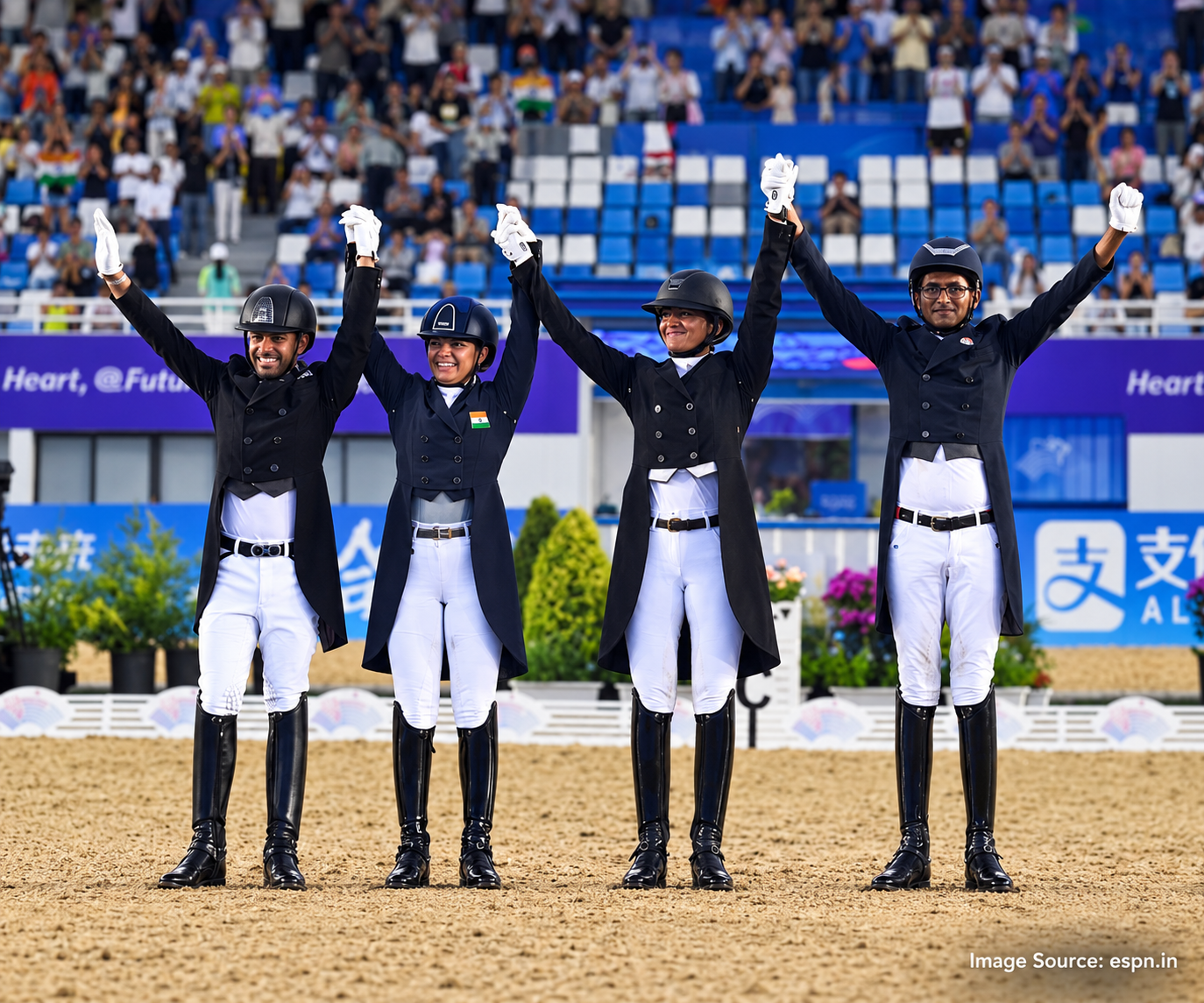
On 26 September 2023, in Hangzhou, China, the Indian dressage team walked into an arena. Four riders and their horses carried more than their own ambitions that day. They were there to win the country’s first dressage gold at the Asian Games. A medal had eluded Indian equestrian sport for decades. By the time they walked out, that wait was finally over.
An Indian dressage team built on years of quiet preparation
The Indian dressage team that made history was Anush Agarwalla riding Etro, Hriday Vipul Chheda on ChemXPro Emerald, Divyakriti Singh astride Adrenalin Firfod, and Sudipti Hajela on her horse Chinski. They represented India in team dressage. It’s a discipline where horse and rider perform a sequence of precise, pre-set movements. Each movement is judged and scored out of ten.
None of them arrived at this moment by accident. Sudipti, the youngest of the four at 21, is originally from Indore. She had been riding since she was six. It started as a hobby, before her father encouraged her to take it seriously. She now trains out of Pamfou in France.
Divyakriti, 23, is from Jaipur. She first took to horse riding as a schoolgirl at Mayo College Girls’ School in Ajmer. Between them, the team spent years training away from the spotlight. They competed internationally, slowly building toward a moment like this one.
How the Indian dressage team won gold
When the results were tallied, India’s top three scores counted toward the final tally. Anush scored 71.088, Hriday scored 69.941, and Divyakriti scored 68.176. Together, they added up to 209.205 percentage points. That was enough to take the top spot on the podium.
China finished second with 204.882 points. Hong Kong took bronze with 204.852. Sudipti’s score of 66.706 wasn’t counted toward the final tally, since only the top three scores are used. Still, her preparation mattered just as much to the team’s overall effort.
It was India’s first-ever team gold in dressage at the Asian Games. It was also the country’s first equestrian gold at the Games in several decades. Most fans watching that day had never seen India win one before.
What it meant to the riders themselves
Speaking after the win, Sudipti Hajela, the youngest of the four, captured what the moment meant beyond the scoreboard. “It is unbelievable to win a gold here,” she said. “It is not an easy journey for any of us. All of us have gone to Europe at a young age. We have worked hard for many years away from our families. We have made a lot of sacrifices.”
Anush Agarwalla recalled the medal ceremony itself. “That was a very emotional moment,” he said. “The national anthem was playing, and the national flag was flying. There was no better feeling than that.” Anush left his home in Kolkata for Europe in 2017 to pursue the sport professionally, a decision that shaped much of his journey to this podium.
That sentiment ran through the whole team’s story. Equestrian sport in India rarely gets the visibility or resources of more popular disciplines. Success at this level usually comes through the persistence of individual families and riders, rather than institutional support. For Sudipti, Divyakriti, Anush and Hriday, the gold in Hangzhou was a tribute to the people who backed them quietly for years. It was also, of course, a personal achievement they had worked toward for a long time.
A moment for a sport that rarely gets one
Equestrian sport doesn’t often make headlines in India. It gets overshadowed by cricket, hockey, and athletics. But the dressage team’s win in Hangzhou offered a reminder. Indian riders have been competing and improving at the international level for years, even without much attention.
India’s success in Hangzhou did not stop at the team event. Anush Agarwalla also won individual bronze in dressage, scoring 73.030 on Etro. That was India’s first-ever individual medal in the discipline at the Asian Games. The victory also opened doors for the sport going forward. It gave young riders around the country a fresh reason to believe a podium finish in equestrian sport is possible for them too.
The Wise Take
There’s something quietly powerful about a sport most of India barely follows producing one of its most emotional gold medals. No stadium roared. No channel ran wall-to-wall coverage. Yet four riders and four horses did something the country had waited over four decades for. It’s a good reminder that history doesn’t always announce itself loudly. Sometimes it happens in an arena most people weren’t even watching, built on years of practice nobody saw.
Also read our other article on India Women’s Cricket Team: How a Team Playing Its First-Ever Asian Games Turned One Final Into a Piece of History
Follow The Wise Indian for more stories from India’s sporting history and the changemakers behind them.



