

In a quiet corner of her Bengaluru home, 16-year-old Manya Harsha sits with a sieve, pressing onion peels into thin sheets of handmade paper. There are no machines around her, just water, pulp, and patience. It’s a small scene, but it captures something bigger about how Manya sees the world: almost nothing needs to be thrown away too soon.
A childhood shaped by her grandmother’s stories
Long before sustainability became a subject she studied, it was something Manya lived. Her journey traces back to her grandmother, V Rudramma. She told Manya stories about planting saplings, collecting flowers, and recycling old fabric into cloth bags for the market. “I saw her recycle old fabrics into cloth bags that she carried to the market. That stayed with me,” Manya recalls. Her mother, Chitrashee Harsha, sees her own mother’s influence running through everything Manya now does. “The older generation lived sustainably without calling it sustainability. They just lived that way,” she says.
That upbringing wasn’t only about stories. Manya was six months old when her parents, Harsha BS and Chitrashee, began taking her travelling. They chose villages, forests and farmlands over commercial cities. “She saw how farmers work in the hot sun, how forests are cut to build cities, and how ecosystems function,” her father explains. Those road trips became her first classroom.
When grief became a project
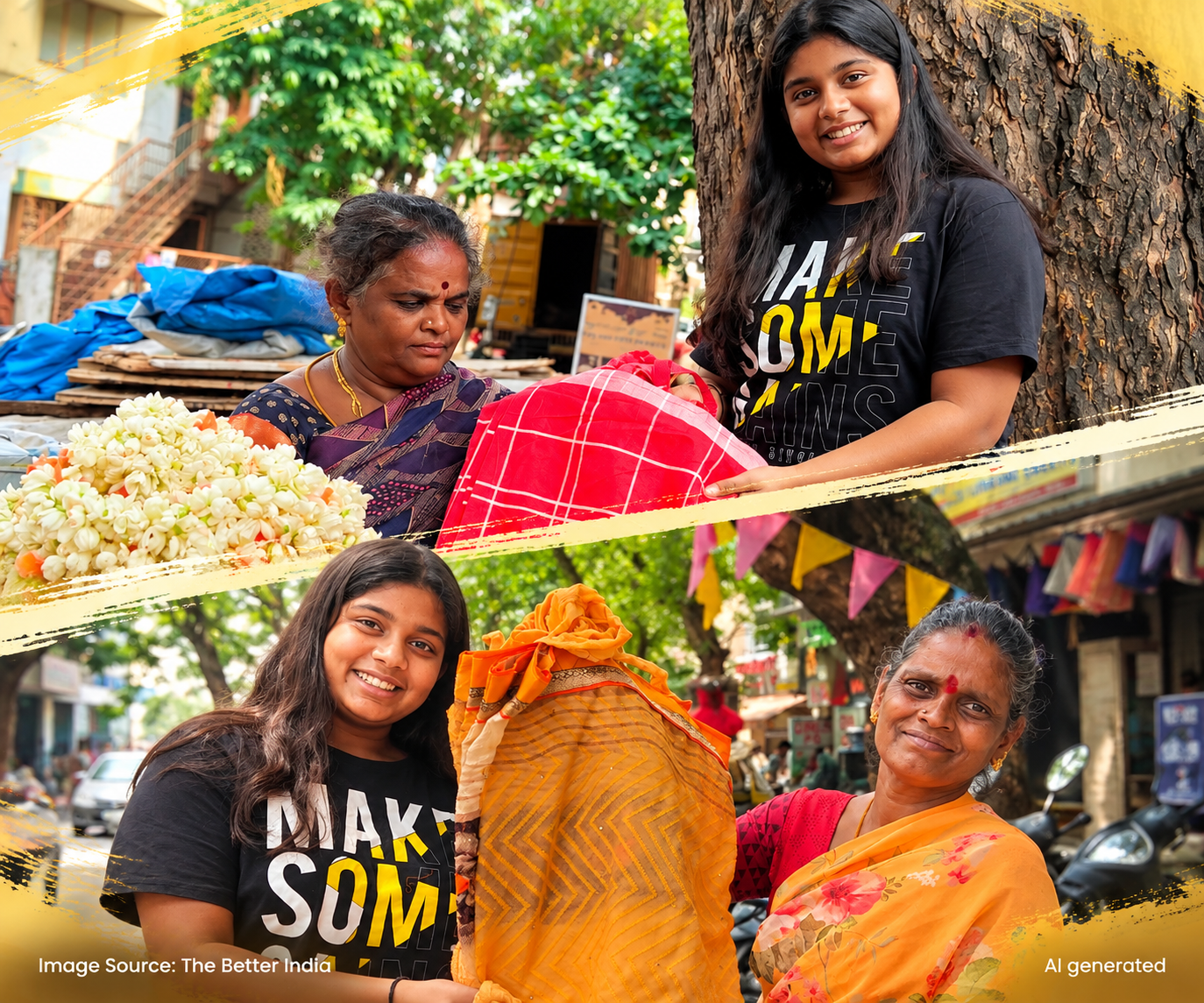
Her grandmother passed away; Manya held onto her memory in the most practical way she knew. “We converted her old sarees into cloth bags and distributed them. That is how Grandma’s Green Weave started,” she says. What began with a handful of sarees at home soon grew into a community effort.
Soon, people across Bengaluru began emptying their cupboards of old sarees and bedspreads. Volunteers collected the fabric and handed it to local tailors. The tailors stitched it into sturdy, reusable bags. In practice, the project runs on three simple steps. It collects old fabric from homes, works with tailors to upcycle it, and uses the process to talk about plastic pollution.
The numbers behind the movement
So far, Grandma’s Green Weave has collected over 2,200 sarees and 230 bedspreads, turning them into more than 28,000 cloth bags, diverting close to 1.2 tonnes of textile waste from landfills in the process. It has also helped avoid an estimated 2,45,000 plastic bags. These bags now reach street vendors, schools and community groups across the city.
Behind those numbers is a deliberate choice about how the project is run. Manya funds it largely through her own award money and family savings. The project accepts no external donations. “Once money enters as donation, it changes the intent. We wanted this to remain a movement, not a business,” Chitrashee explains. The cost of stitching each bag has also risen over time, from Rs 7–9 in 2023 to around Rs 20 today.
The people doing the stitching have their own stake in the project. Sayta Arjun, one of the tailors working with the initiative, says it changed how she sees her own old clothes. “After seeing this project, even I felt that I could reuse my old sarees and make them into cloth bags,” she shares, adding that her involvement isn’t driven by the modest per-bag payment but by being part of something worthwhile.
Beyond sarees: paper from vegetable peels
Manya’s instinct to look twice at waste shows up elsewhere too. Watching her mother peel onions one day, she noticed the peels resembled paper and began experimenting, eventually working with carrot peels, corn cobs, coconut husks and citrus rinds to make usable sheets. “I have papers from 2020, and they are in perfect condition even now,” she says.
She also takes this into classrooms. There, she runs workshops where children make seed pencils. Once used up, those pencils can be planted. Alongside all this, she has written nine nature-themed books. She also edits Sunshine Fortnightly, a magazine that brings climate conversations to young readers.
The Wise Take
What stands out about Manya’s story isn’t a single dramatic moment; it’s the steadiness of it. Over time, that habit grew into a system of tailors, neighbours and thousands of reused sarees. Her granddaughter simply refused to let it disappear. It’s a reminder that the biggest environmental shifts don’t always start with a campaign or a policy. Sometimes they start with someone simply refusing to let a good habit die with the person who taught it to them.
Also read our other article on Two Indian Lakes Went on an International Danger List in 1993. Chilika Came Off in 2003 and Loktak Is Still There
Follow The Wise Indian for more articles like this.



