

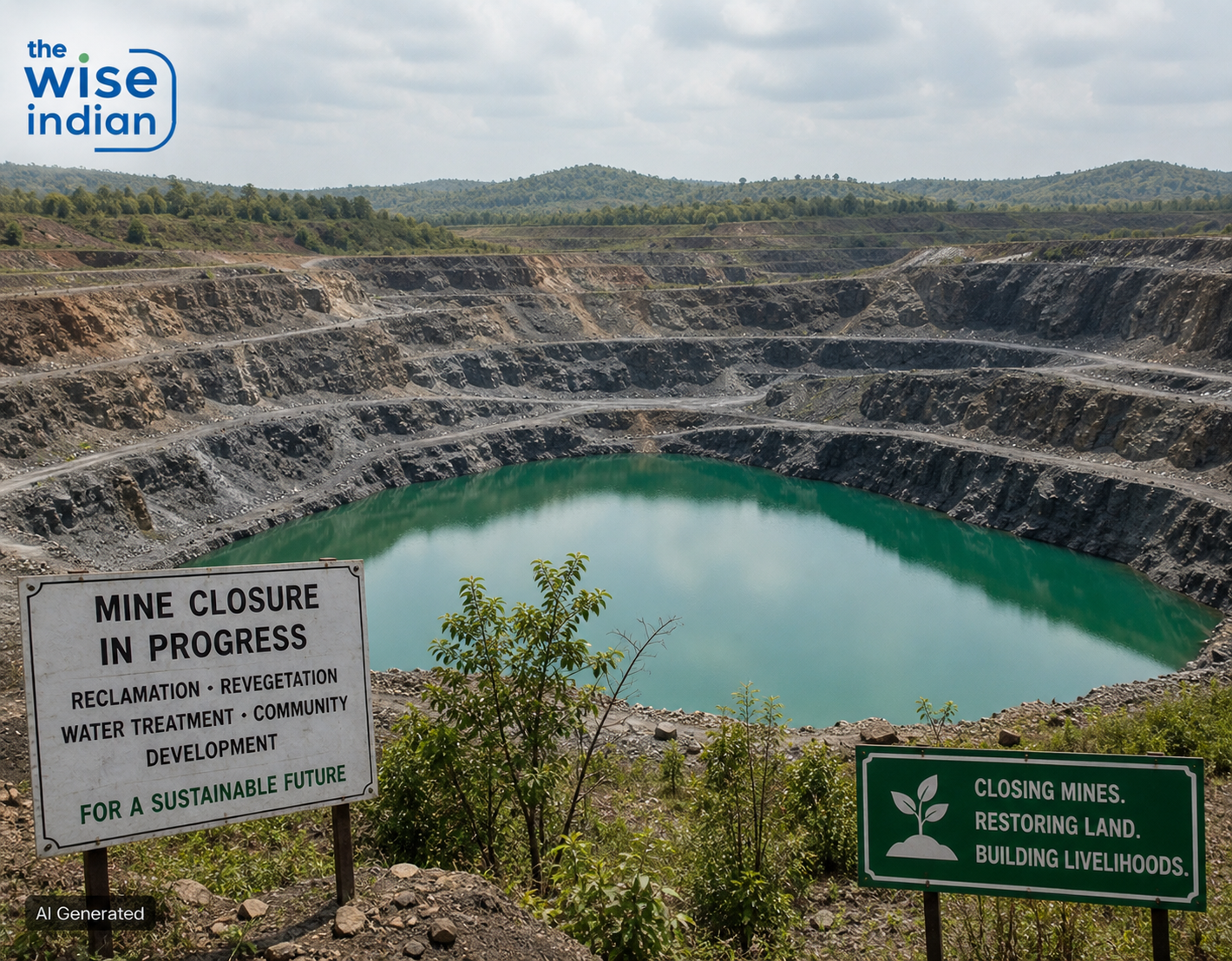
A report released in July sets out a plan to close 147 mines scientifically, and for the first time coal mine closure rules count people as well as land.
When a coal mine stops producing, it does not simply stop. Pits fill with water, ground subsides, dust stays in the air, and the settlement around the mine still stands. India has around two centuries of that history behind it. Yet detailed coal mine closure rules have only arrived recently.
What the Ministry Announced in July
The Ministry of Coal released its annual report on mine closure, called AAROH, on 22 July 2026. It records 42 abandoned coal mines reclaimed so far.
Alongside it the ministry set out the RECLAIM framework. It also set a plan to close 147 mines scientifically over two to three years, on a corpus of about Rs 40,000 crore. India then signed an agreement with the German agency GIZ, covering closure and later land use.
Where the Coal Mine Closure Money Comes From
That Rs 40,000 crore is not a fresh allocation from the budget. Operators fund closure themselves in India, through escrow accounts opened before a mine may start.
The amount depends on area, at roughly Rs 14 lakh per hectare for opencast mines and Rs 2 lakh for underground ones. A scheduled bank holds the account under the Coal Controller’s Organisation. Money goes back to the company only against verified closure work.
So the figure describes a liability that had already built up on the books. What has changed is the speed of spending.
The Rules Have Been Rewritten Five Times
The Ministry of Coal issued its first full closure guidelines in August 2009, then revised them in 2012, 2013, 2019 and 2020. The 2020 version made closure a compulsory part of the mining plan.
Guidelines issued in October 2022 covered mines abandoned or discontinued before 2009, which had no closure plan at all. Then the January 2025 revision widened it again, to cover community development, livelihoods and later land use.
What Closing a Mine Involves
South Eastern Coalfields has identified 54 abandoned mines and closed 28, three in 2024-25 and twenty-five in 2025-26. The work means sealing underground openings, demolishing structures and treating subsidence, before reclamation and planting begin.
Mahanadi Coalfields has signed escrow agreements for 20 mines, with a quarter of each closure plan set aside for community development and livelihoods.
The Wise Take
The difference between an abandoned mine and a discontinued one is worth holding on to. An abandoned mine is one nobody intends to reopen. A discontinued mine may reopen if the technology improves. For the people living beside it, though, that difference is mainly on paper, because either way the pit stays and the work does not come back. Estimates put the number of Indians dependent on the fossil fuel economy above 21 million. Sealing a shaft and planting trees is the part of coal mine closure anyone can measure. The part nobody can measure is what those workers do next.