
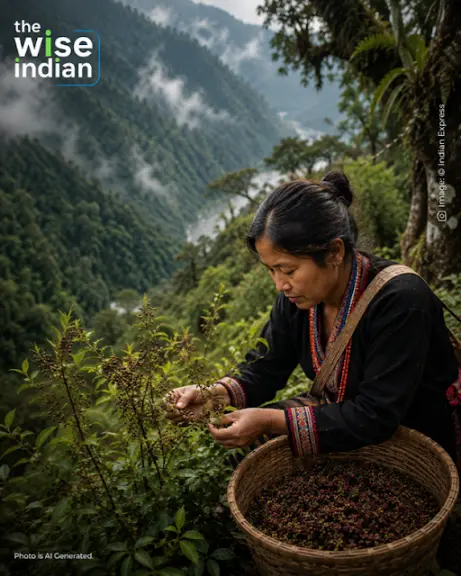
Khagi was always harvested in West Kameng. Turning it into an organised trade gave the villages a financial argument for keeping the forest intact.
Khagi is a wild Himalayan spice with a citrusy, tongue-tingling flavour, harvested for generations by Indigenous communities in Arunachal Pradesh. Botanically it belongs to the Zanthoxylum genus, the group that also gives the region its pepper-like seasonings.
In the Mandala Phudung Khellong Community Conserved Area in West Kameng district, that spice has become the reason more than 100 square kilometres of community-owned forest is being protected.
What a Community Conserved Area Is
Community Conserved Areas are forests, wetlands or grasslands that Indigenous and local communities voluntarily protect and manage themselves.
They differ from national parks and sanctuaries in a way that matters. A protected area is declared by government; a CCA is governed by community consensus, with villagers deciding what may be used, what is restricted, and how benefits are shared. Many villages across Arunachal Pradesh have set them up.
Why the Old Systems Were Weakening
Traditional governance of this kind depends on the forest being central to how a household lives. As communities shift from subsistence to cash economies, that link loosens and the village institutions enforcing restraint lose their grip.
Expanding roads and infrastructure have fragmented forests at the same time. WWF India has been working with Indigenous communities and traditional village institutions over recent years to strengthen CCAs across the state.
Making the Forest Pay for Itself
The intervention in Mandala Phudung Khellong was economic rather than regulatory. Villagers built a community-led system to harvest Khagi sustainably, aggregate it and market it, so that the spice generates income only for as long as the forest that produces it remains standing.
The arrangement supports more than 200 households and protects habitat used by endangered wildlife. Restraint stops being an act of sacrifice and becomes the thing that protects the revenue.
The Wise Take
Conservation in India usually asks people living beside a forest to accept a cost so that a wider public gets a benefit, which is why so much of it is resented and quietly ignored. The Khagi arrangement inverts that: the households nearest the forest are the ones earning from it, and the incentive to over-harvest is checked by the fact that they, not a distant department, set the rules. It is not automatically replicable, because it needs a species with genuine market demand and village institutions still strong enough to enforce a decision. Where both exist, this is a considerably cheaper way to keep a forest than fencing it.