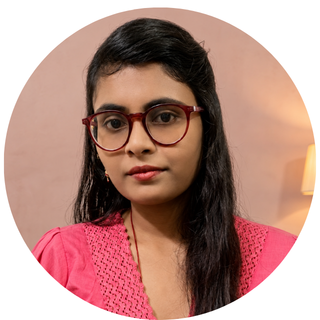
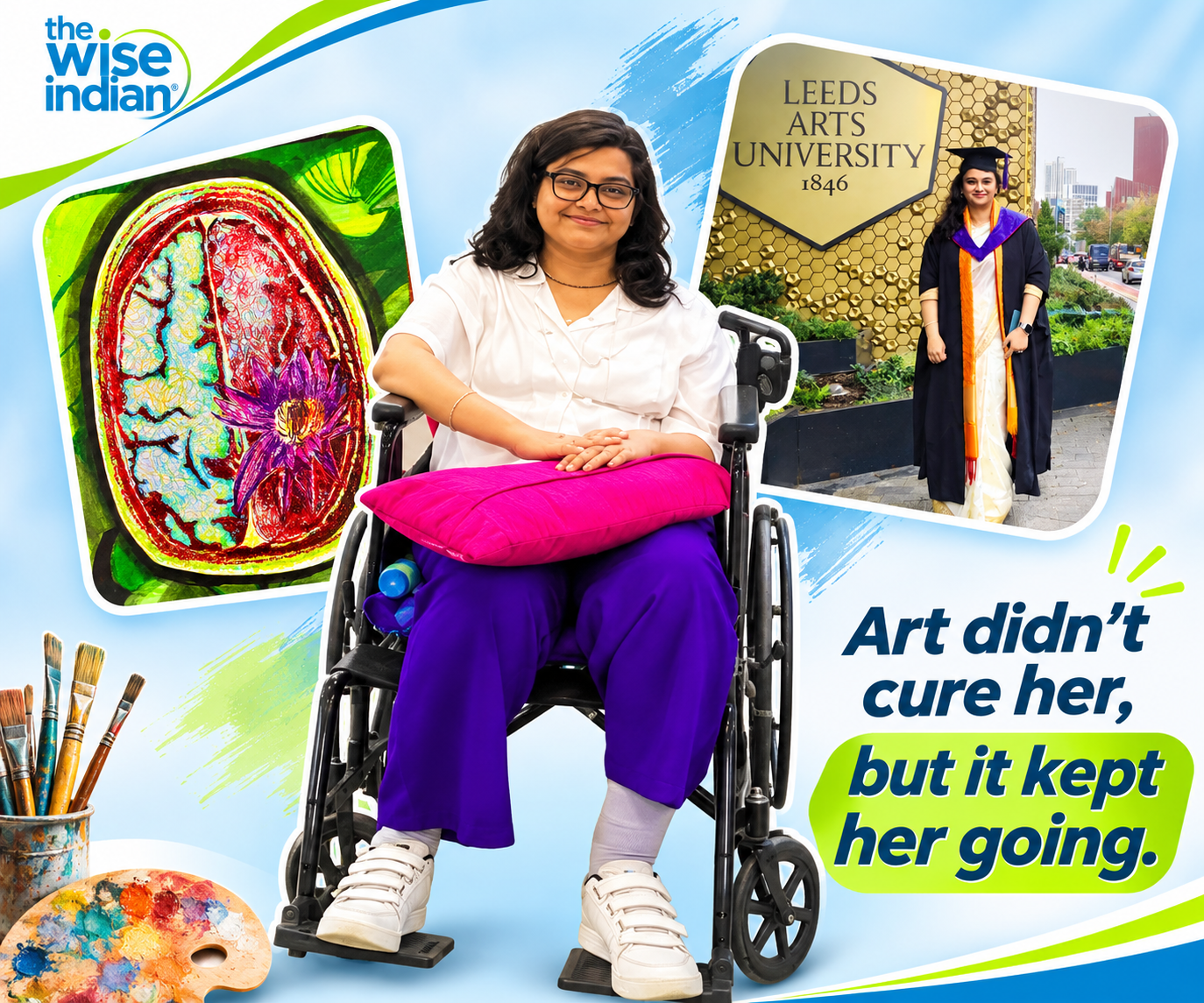
A brain scan is often used to find medical answers. For artist and researcher Sapna Singh, it became the starting point for a lotus painting. Months after moving to the United Kingdom for a PhD, she learned that she had a cancerous brain tumour. A seizure then left the left side of her body paralysed, and suddenly changed her independence. Yet, amid hospital visits, surgery and rehabilitation, she kept asking for paper and a pen.
Drawing offered a familiar way to face uncertainty. Her story is not about art curing illness. It is about holding on to identity while learning to live with a changed body. That lotus painting became a personal symbol of that effort. It also brought together two parts of her life that had once seemed separate: the medical experience she was facing and the creative practice that had shaped her for decades.
A lifelong relationship with art and learning
Growing up in Delhi, Sapna Singh was drawn to sketching from an early age. By Class 9, she was making portraits, and she chose painting in Class 11. She failed the entrance examination for Delhi’s College of Art twice, in 1999 and 2000. She tried again, gained admission in 2002 and graduated in 2006, finishing second in her final year.
After moving to Dubai with her family in 2016, she began teaching art and later joined Manipal Academy of Higher Education in Dubai. There, she taught animation, media and communication. In September 2022, she enrolled in a design master’s programme at Leeds Arts University, specialising in world-building and creature design. She completed it in a year. Her journey reflects a determination to keep learning.
A PhD dream interrupted by a serious diagnosis
In 2024, she received a Vice-Chancellor’s Scholarship to pursue doctoral research at the University for the Creative Arts. Her proposed work examined artificial intelligence’s impact on creative education and recruitment. She moved to the UK with her son, Kabir, in October 2024. But in February 2025, she noticed weakness in her left hand and leg. An MRI revealed a cancerous brain tumour. A seizure later left the left side of her body paralysed.
Her focus shifted to treatment and daily needs. She returned to India in April 2025 and underwent surgery at Fortis Hospital in Noida. Her recovery included chemotherapy, radiation, physiotherapy and rehabilitation. Even bathing, dressing and moving from bed to a wheelchair required help. Walking became a gradual goal rather than an automatic part of daily life. Her family adjusted to new responsibilities. The interruption to her PhD was significant, but she has not abandoned the hope of returning to it.
The MRI image that became a lotus painting
Even during the medical emergency, she wanted to draw. She asked a nurse for a pen and paper, using art to move her thoughts away from fear. Her right hand, which she used for painting and writing, remained functional. It let her return to a familiar activity. One meaningful work grew from that MRI image. Rather than reproduce the scan as a clinical picture, she represented the tumour as a lotus. She associated the flower with wisdom and awakening, giving the frightening image a new meaning.
The lotus painting gave her a new way to approach the experience. It did not change the medical reality, but it changed how she could engage with that experience. It turned diagnosis into personal expression. Painting was not always easy. Vision difficulties made fine details harder, once central to her work. Instead of stopping, she began adapting her approach and experimenting with patterns. Her husband, Akshay, saw her reconnect with art. The painting became a way to express fear, frustration, loneliness, hope and gratitude when ordinary conversation did not always feel enough.
Rebuilding independence, one step at a time
Recovery has been slow and uneven. At first, she needed four people to help her walk. Over time, that support reduced to three, then two and eventually one. She has managed a few steps without assistance, though walking alone remains a goal. Fatigue and vision problems remain, and some daily tasks still need assistance. She now measures progress through small changes. She is regaining control over routines and continuing creative work. Her son has witnessed the changes, while her husband supports her rehabilitation.
Painting and writing have remained part of her routine, alongside plans for an autobiography and a solo exhibition. In March 2026, she took part in a four-day College Mate exhibition at a gallery near Parliament House in Delhi. The exhibition let her share her work again after months of treatment. It showed that her creative life had not disappeared during illness. She hopes to return to her doctoral research when her health allows. They remain goals, pursued at her own pace.
The Wise Take
The lotus painting carries a message beyond its subject. It shows how expression can help someone face an experience they did not choose. For this artist, creativity did not replace surgery, medical care or rehabilitation. It offered familiarity while much else had changed. That distinction matters. Art should not be presented as a cure for a brain tumour or paralysis. Recovery is different for everyone. It can offer meaning, structure and a way to communicate difficult feelings. Her journey also shows that ambition has no age limit.
She returned to study after years of teaching and work, and she still hopes to complete the research interrupted by illness. There is no fixed timeline, and she has not suggested that every day is positive or easy. For now, the painting, the writing and each small step forward are part of a life being rebuilt with patience. This lotus painting is not a symbol of an effortless victory; it is a reminder that hope can exist alongside uncertainty.
Also read our other article on How Hyderabad Doctor Dr Sivaranjani Santosh Made an Expensive Rare Disease Medicine Affordable
Follow The Wise Indian for regular updates on stories that shape India’s strategic future and global standing. Stay connected with us for sharp analysis, untold perspectives, and a closer look at the shifting legal landscapes, civic rights, and institutional frameworks defining our democratic fabric.