
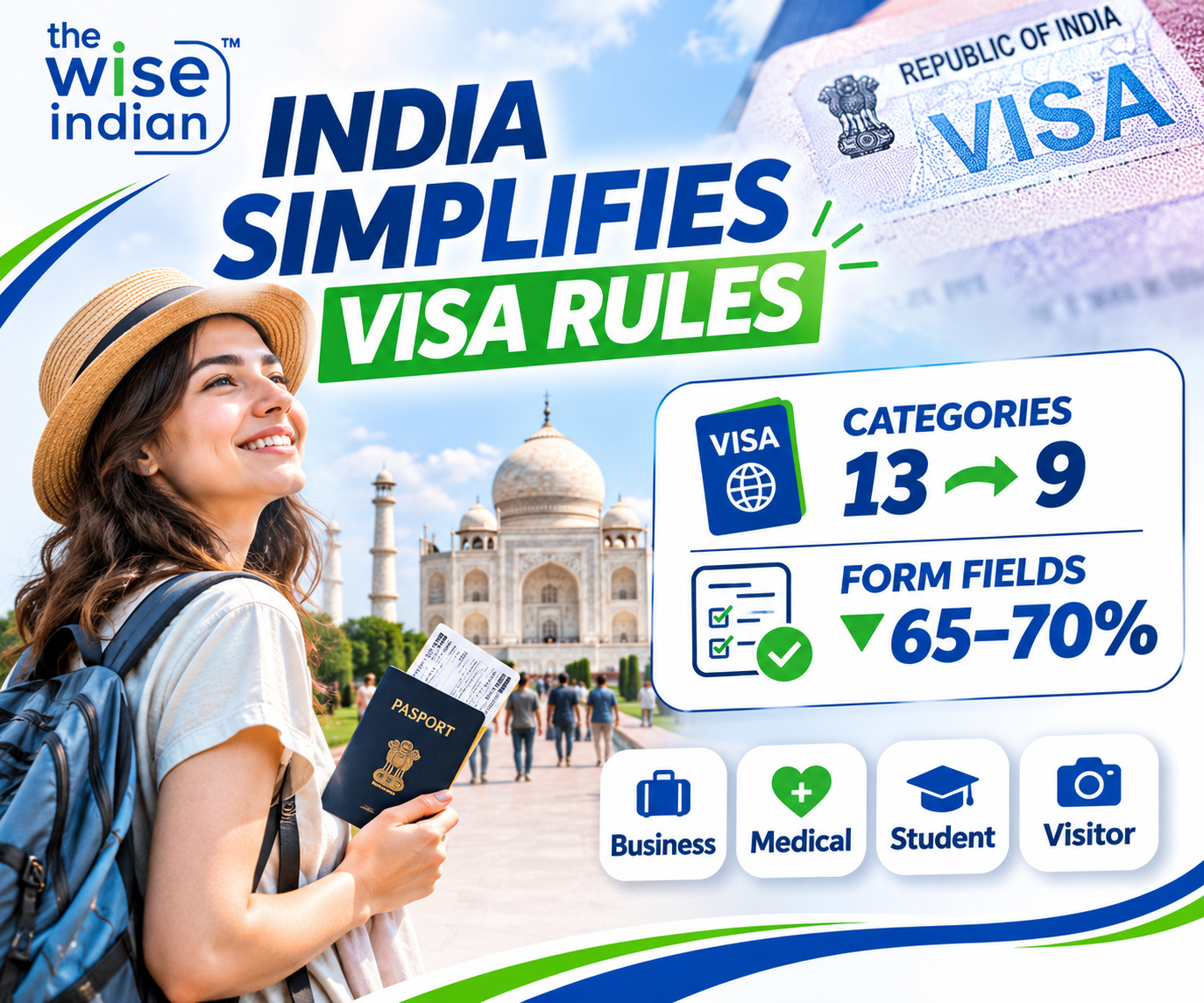
India has introduced significant changes to its visa framework to make international travel and entry procedures easier for foreign nationals. The Ministry of Home Affairs (MHA) has reduced the number of main visa categories from 13 to nine. It has also reduced sub-categories from 49 to 23 and shortened application forms by 65–70%.
These changes aim to simplify applications for tourists, medical visitors, international students, researchers and business professionals. The government announced the details on November 11, 2026, following changes introduced on August 27. The revised framework brings several overlapping travel purposes together under clearer categories. However, the updated information technology systems are still being prepared. The government expects visa issuance under the revised framework to begin by the end of 2026.
Why Has India Restructured Its Visa Framework?
The latest changes form part of a wider effort to simplify India’s immigration procedures. In October 2025, the government reduced the main visa categories from 22 to 13. It also reduced the sub-categories from 63 to 49 during that exercise. The Ministry of Home Affairs introduced another round of rationalisation on August 27, 2026. This brought the numbers down further to nine main categories and 23 sub-categories.
According to the ministry, the government studied visa systems in developed countries and considered international practices before making these changes. The review identified overlapping purposes across several existing categories. Consequently, the authorities consolidated similar activities to make visa selection easier for applicants. The nine categories now cover Business, Diplomatic, Work, Journalist, Medical, Official, Student, Visitor and Miscellaneous Visas. Each category addresses a broad purpose of travel, while its sub-categories specify the activities permitted.
The India visa rules therefore retain different eligibility conditions despite having fewer main categories. The reform does not mean that foreign nationals can enter India without the appropriate visa or supporting documents. Applicants must still satisfy the requirements applicable to their intended activities. The government expects this clearer structure to support legitimate travel, education, healthcare and economic engagement.
Tourist Visa Renamed as Visitor Visa
One important change is the renaming of the former Tourist Visa as the Visitor Visa. The new category accommodates several short-term activities beyond conventional sightseeing. The government has divided it into two sub-categories, V-1 and V-2, according to the purpose and duration of visits. The V-1 Visa provides 30-day validity with multiple entries. It covers tourism, short-term business meetings, medical consultations, wellness retreats and short-duration medical treatment. Eligible short courses in Indian languages, music, art and craft also fall under this category. Short-duration yoga programmes are included as well.
Meanwhile, the V-2 Visa caters to longer visits and offers validity options of one, five or ten years, subject to eligibility. It covers activities permitted under V-1 and also includes mountaineering. A separate six-month multiple-entry provision applies to mountaineering visits. This wider arrangement could benefit visitors who combine tourism with cultural learning, wellness activities or eligible business meetings. However, applicants should not assume that every activity qualifies automatically. They must check the specific conditions before selecting a category. The revised India visa rules aim to make these distinctions clearer while providing suitable options for different visitors.
Medical and Student Visa Categories Reorganised
The government has also revised provisions for foreign nationals travelling to India for healthcare and education. The Medical Visa framework distinguishes between conventional medical treatment and treatment under AYUSH systems. The M-1 Visa covers medical treatment other than AYUSH, while the M-3 Visa applies to AYUSH treatment. Both categories, including their electronic visa variants, have a default validity of one year with multiple entries.
The corresponding M-2 and M-4 categories cover attendants accompanying patients under M-1 and M-3, respectively. These provisions can help patients who require consultations, procedures and follow-up treatment during their stay. The Student Visa category has also been organised into S-1 and S-2. The S-1 Visa covers school, graduate and postgraduate education. Meanwhile, S-2 accommodates PhD scholars, research students, visiting faculty, internships and exchange programmes, among other specified academic activities.
Foreign students admitted through the Study in India portal may also receive an e-S1 Visa. It can provide validity for up to five years or the duration of the academic course, whichever is shorter. The facility also permits multiple entries. These provisions may support international students and researchers seeking academic opportunities in India. They also give eligible medical visitors and their attendants clearer visa arrangements.
Business Visa Changes Target Investment and Technical Expertise
The revised framework also reorganises Business Visas to distinguish between long-term ventures and short-term assignments. The B-1 category covers long-term business activities, including establishing industrial and commercial ventures in India. In contrast, B-2 covers specified short-term activities involving contractual assignments and commercial engagement. These include conferences, sports, cultural performances, film production and production investment business. The changes also introduce a specific provision for foreign technical specialists, engineers and subject-matter experts engaged by Indian companies.
Their work may involve installing and commissioning equipment, conducting quality checks, maintaining machinery and supporting industrial production. Other eligible activities include technical training, IT and enterprise resource planning operations, plant design and technology transfer. Such specialists may receive a Production Investment Business Visa under the B-2 category through the e-visa platform. This provision was previously available under the e-B4 visa nomenclature.
The distinction between B-1 and B-2 could help businesses identify suitable visa options for different commercial requirements. It may also support companies that need overseas expertise to establish facilities or introduce specialised technology. However, a Business Visa does not automatically authorise every type of employment in India. Foreign professionals must follow the permitted activities and applicable conditions. The revised India visa rules seek to provide greater clarity for investors and companies engaging international specialists.
The Wise Take
Alongside category changes, the government has undertaken a separate exercise to shorten visa application forms. The Ministry of Home Affairs has reduced the required fields by 65–70% across all 23 revised visa sub-categories. This means applicants will need to provide less information while still submitting essential details required for processing. The ministry expects shorter forms to reduce applicants’ time and effort. It also expects the changes to support administrative efficiency and more focused scrutiny.
Meanwhile, India currently offers electronic visas to nationals of 172 countries through 13 e-visa sub-categories. This existing e-visa arrangement is separate from the nine main categories in the revised framework. The distinction is important because the two figures describe different parts of the visa system. The MHA is updating its information technology systems to implement the new arrangements.
According to the government, visas under the revised framework are expected to be issued by the end of 2026. Therefore, applicants should check the official Indian visa portal for the latest operational instructions before applying. Overall, the India visa rules reform aims to make travel, healthcare, education and business visits easier to navigate. Its actual impact will depend on smooth implementation and clear guidance for foreign applicants.
Also read our other article on Hyderabad Student Builds a ₹68,000 Satellite Receiver to Bring Weather Images to Remote Himalayan Villages
Follow The Wise Indian for regular updates on stories that shape India’s strategic future and global standing. Stay connected with us for sharp analysis, untold perspectives, and a closer look at the shifting legal landscapes, civic rights, and institutional frameworks defining our democratic fabric.