
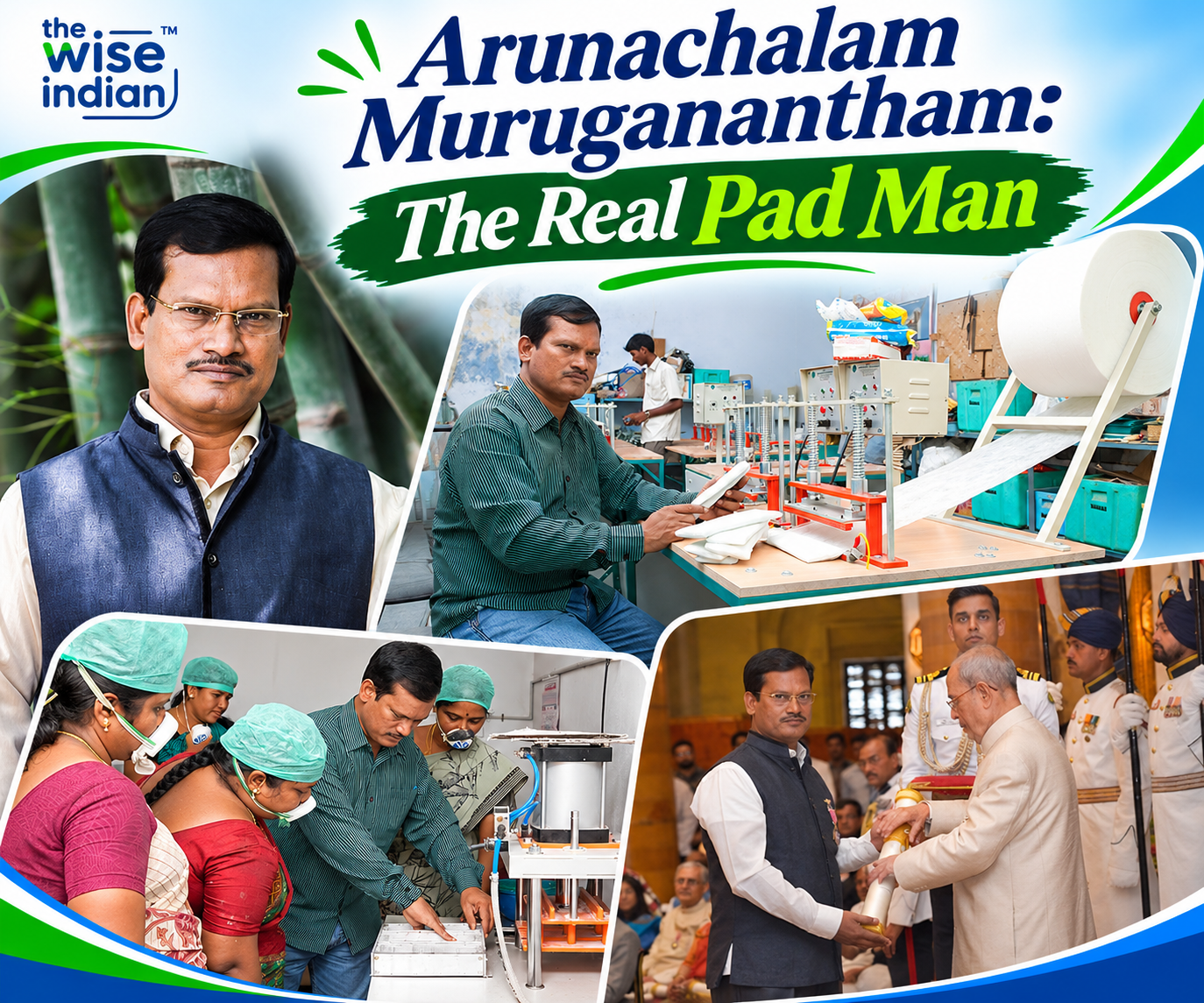
Arunachalam Muruganantham is an Indian inventor and social entrepreneur who transformed menstrual hygiene through an affordable technological innovation. Popularly known as the Pad Man of India, he developed a low-cost sanitary pad-making machine for rural communities. His invention helped women access affordable menstrual products while creating opportunities for independent employment. What makes his achievement remarkable is his unconventional journey. Despite leaving school at a young age, he challenged social taboos and an established manufacturing industry. His determination eventually turned a personal concern into an innovation with international recognition.
A Personal Problem That Inspired an Invention
Born into a financially struggling family in Coimbatore, Tamil Nadu, Muruganantham experienced hardship during childhood. His father worked in the handloom industry but died in an accident when Muruganantham was young. Consequently, his mother worked hard to support the family. Financial difficulties forced him to discontinue his education. He subsequently took several jobs, including work as a farm labourer, machine operator and welder.
His journey towards innovation began after marrying Shanthi in 1998. One day, he noticed his wife collecting old clothes for menstrual use. When he questioned her, she explained that commercial sanitary napkins were too expensive. Buying them regularly meant reducing the family’s milk budget. This conversation revealed a larger problem affecting women in rural communities. Many could not afford commercially manufactured products and relied on less hygienic alternatives.
Rather than accepting the situation, Muruganantham decided to develop an affordable solution. Initially, he wanted to make sanitary napkins for his wife. However, he gradually recognised that millions of women faced similar difficulties. His determination to address this overlooked problem became the foundation of his invention.
Breaking Taboos Through Unusual Experiments
Developing a suitable sanitary napkin proved much harder than Muruganantham initially expected. He experimented with different materials, beginning with cotton. However, his early products failed to match the absorption quality of commercial sanitary pads. He also struggled to understand the manufacturing process because established companies closely guarded their production methods. His wife and sisters eventually stopped participating in his experiments. Menstruation remained a sensitive subject, and discussing it openly created discomfort within the community. Nevertheless, he continued researching the problem. He approached female medical students to test his prototypes, hoping they would provide useful feedback. Unfortunately, many participants felt uncomfortable discussing their experiences.
Therefore, Muruganantham developed an unusual testing method. He created an artificial uterus using a bladder filled with animal blood. He connected it to a sanitary pad and wore the arrangement to test absorption during movement. Although villagers misunderstood his experiments, he refused to abandon his research. After approximately two and a half years of experimentation, he discovered that commercial sanitary napkins used cellulose fibres derived from wood pulp. This discovery helped him understand the essential material behind effective sanitary products. More importantly, his experiments demonstrated the importance of practical research and persistence.
Creating an Affordable Sanitary Pad Machine
Once Muruganantham understood the materials, he focused on manufacturing. Large companies used expensive industrial equipment that required substantial investment. Such machinery was unsuitable for small rural businesses. Therefore, he began designing a simpler alternative that communities could operate locally. His solution involved a compact production system consisting of machines that performed different manufacturing stages. These included processing the raw material, forming the absorbent core, sealing the pads and preparing the finished products. The system reduced the investment required to establish a manufacturing unit.
In 2006, his innovation received the National Innovation Foundation’s Grassroots Technological Innovations Award at IIT Madras. This recognition brought wider attention to his work. It also helped establish his reputation as a grassroots inventor who could solve practical problems without conventional engineering qualifications. Through Jayaashree Industries, he began manufacturing and distributing the machines. Instead of competing directly with large sanitary product companies, he promoted decentralised production. His approach allowed smaller organisations to manufacture affordable sanitary napkins within their own communities. Consequently, the invention offered both a technological solution and a practical business opportunity.
Empowering Rural Women Through Local Manufacturing
One of the most important aspects of Muruganantham’s innovation was its focus on women’s economic independence. He understood that affordable sanitary products alone could not solve every problem. Women also needed opportunities to participate in production and earn sustainable incomes. He encouraged women’s self-help groups, rural organisations and community institutions to establish small manufacturing units. These groups could purchase the machinery, manufacture sanitary napkins and distribute them within nearby communities.
As a result, women became producers and entrepreneurs rather than simply consumers. This model offered several advantages. Local manufacturing reduced dependence on distant suppliers and created employment opportunities within villages. Moreover, community-based production encouraged conversations about menstruation. Women could discuss menstrual hygiene more openly when local groups actively supported awareness and accessibility. His approach gradually attracted attention beyond India.
The National Innovation Foundation documented his portable manufacturing system and its affordability. His innovation demonstrated how appropriate technology could address practical challenges while supporting local entrepreneurship. According to reporting by NDTV, his organisation had established thousands of sanitary pad production units across India. His work also reached international communities seeking affordable menstrual hygiene solutions. Thus, a project that began within one household developed into a wider social enterprise.
Recognition and the Pad Man Legacy
Muruganantham’s contribution eventually earned recognition from several national and international institutions. In 2014, TIME magazine included him among its 100 Most Influential People. The recognition highlighted his contribution to menstrual hygiene and grassroots innovation. In 2016, the Government of India awarded him the Padma Shri. This civilian honour recognised his contribution to society through affordable sanitary technology. However, he continued emphasising that awards were not the ultimate purpose of his work. His larger ambition involved improving menstrual hygiene access and creating dignified employment for rural women.
His extraordinary journey also inspired the 2018 Bollywood film Pad Man. Directed by R. Balki and starring Akshay Kumar, the film introduced his story to a much wider audience. It encouraged conversations about menstrual health, affordability and the social stigma surrounding menstruation. Today, Muruganantham remains an important example of grassroots innovation. His work demonstrates that meaningful technological progress does not always begin in advanced laboratories. Sometimes, it starts with observing an everyday problem and refusing to ignore it.
The Wise Take
Arunachalam Muruganantham transformed a personal concern into an innovation that challenged social attitudes and manufacturing practices. His journey proves that formal qualifications do not determine someone’s ability to solve meaningful problems. Through persistence, practical experimentation and an understanding of community needs, he created opportunities for women across different regions. More importantly, he helped bring menstrual hygiene into public conversations. His story reminds us that true innovation is not simply about inventing machines. It is about improving lives, protecting dignity and making essential resources accessible to everyone.
Also read our other article on The Helmet Man of India: How Raghavendra Kumar Turned Personal Loss Into a Nationwide Mission to Protect Lives
Follow The Wise Indian for exclusive stories celebrating everyday heroes who are quietly shaping the culture, sustainability, and future of a better India.