
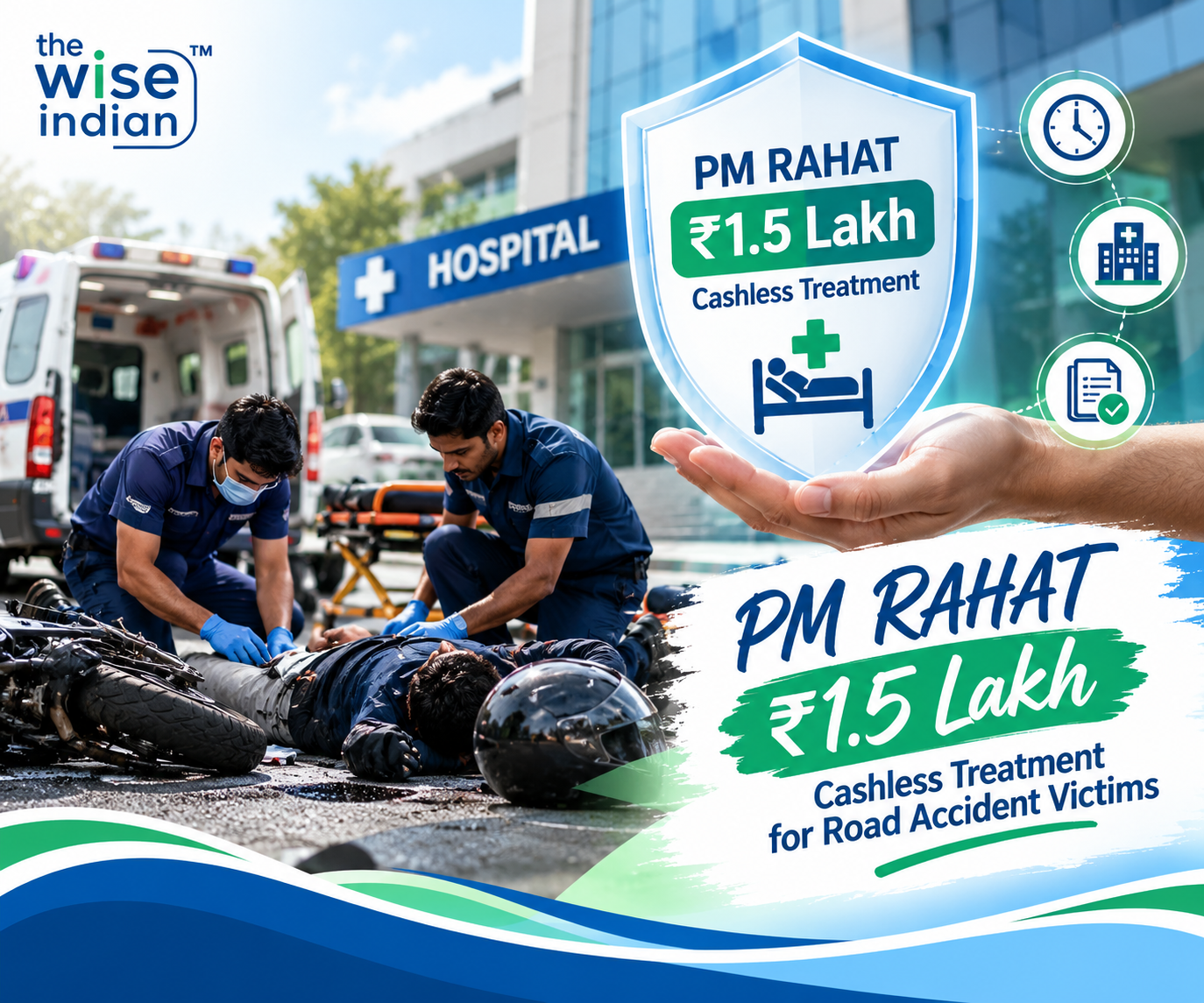
A road accident can leave victims facing urgent medical needs and families struggling to arrange hospital expenses. India’s PM RAHAT scheme aims to remove that financial barrier during a critical emergency. It offers cashless treatment worth up to ₹1.5 lakh for each eligible road accident victim. However, the benefit comes with specific time limits, hospital requirements and verification procedures. Knowing these conditions can help people understand what the scheme covers and how to seek assistance.
PM RAHAT’s Coverage and Eligibility
PM RAHAT stands for Prime Minister – Road Accident Victims’ Hospitalisation and Assured Treatment. It operates under Section 162 of the Motor Vehicles Act, 1988. The government notified the underlying Cashless Treatment of Road Accident Victims Scheme on May 5, 2025. It issued implementation guidelines on June 4, 2025, and launched PM RAHAT nationwide on February 13, 2026. The scheme covers a person injured in a road accident caused by a motor vehicle. It applies to accidents on any category of road.
Eligibility does not depend on the victim’s income or vehicle ownership. However, it is not general health insurance. The injury must arise from a qualifying motor-vehicle accident, and treatment must follow the scheme’s conditions. Eligible victims can receive cashless treatment up to ₹1.5 lakh per person. The benefit runs for a maximum of seven days from the accident date, not hospital admission. The ceiling applies separately to each victim. Therefore, multiple injured people in one accident may each qualify. The scheme uses prescribed treatment packages and rates; it does not promise unlimited payment for every medical expense.
PM RAHAT’s Seven-Day and Hospitalisation Rules
The seven-day limit and ₹1.5 lakh ceiling are separate restrictions. A victim cannot obtain a fresh seven-day period by moving hospitals. Similarly, a transfer does not reset the financial limit. The total eligible treatment remains subject to the same cap and accident date. Another important timing condition concerns the first hospitalisation. The scheme guidelines state that victims first hospitalised more than 24 hours after the accident are ineligible. This condition differs from the stabilisation period provided after admission.
Therefore, victims should seek medical attention immediately. They should not assume that the seven-day coverage allows them to delay their first hospital visit. At a designated hospital, stabilisation treatment is available for up to 24 hours in non-life-threatening cases. In life-threatening cases, the period extends to 48 hours, subject to police response. Stabilisation means urgent care to assess and manage the patient’s condition. These periods do not replace or extend the overall seven-day coverage.
Emergency Response, Hospitals and Verification
A victim, relative or bystander can dial 112, India’s Emergency Response Support System. They can obtain details of the nearest designated hospital and request ambulance assistance. A person who voluntarily helps an injured victim is recognised as a Good Samaritan, or RAH-VEER. The scheme connects emergency responders, police and hospitals to help victims reach care quickly. Treatment is available through designated hospitals. Hospitals empanelled under Ayushman Bharat Pradhan Mantri Jan Arogya Yojana may also qualify. However, they must meet PM RAHAT requirements.
This does not make PM RAHAT part of Ayushman Bharat. Instead, it is a separate statutory scheme that uses existing hospital networks and digital infrastructure. The hospital starts treatment and creates a treatment identification record through the National Health Authority’s Transaction Management System, or TMS 2.0. It sends the details to district police through eDAR, the accident-reporting platform. Police generally have up to 24 hours to respond. In life-threatening cases, they have up to 48 hours, as determined by the hospital administrator. Meanwhile, urgent treatment can begin while verification proceeds.
PM RAHAT Funding, Claims and Accountability
The scheme reimburses hospitals; it does not transfer ₹1.5 lakh directly to victims’ bank accounts. Payments come through the Motor Vehicle Accident Fund. General insurance companies contribute towards cases involving insured offending vehicles. Meanwhile, Central Government budgetary support covers uninsured and hit-and-run cases. After discharge, the hospital submits its claim through the digital system. The State Health Agency verifies the claim and may approve or reject it, fully or partially.
Once approved, the applicable District Collector or General Insurance Council must arrange payment. The defined payment period is 10 days from claim approval. The scheme also provides grievance channels at district, state and national levels. District Road Safety Committees monitor implementation. A designated grievance officer or contact point receives complaints. If necessary, unresolved matters can move to the District Collector and State Road Safety Council. Authorities can act against hospitals refusing eligible victims, including disciplinary measures or removal from the empanelled network.
The Wise Take
The government’s implementation figures offer an early indication of reach. By July 31, 2026, 22,481 victims across 34 States and Union Territories had benefited. State Health Agencies had approved claims worth ₹12.59 crore. Of this amount, ₹10.56 crore had been paid to hospitals. These figures show implementation progress, not proof that the scheme has already reduced road deaths.
PM RAHAT could make emergency treatment more accessible by reducing the need for families to arrange money first. However, its success depends on public awareness, adequate designated hospitals, prompt police verification and timely reimbursement. In an emergency, calling 112 and reaching a designated hospital quickly are practical first steps. Ultimately, the scheme’s promise will be measured by whether eligible victims receive timely care when every minute matters.
Also read our other article on 19-Month-Old Cheetah Dies After Gunshot Injuries Near Kuno National Park as Central and Madhya Pradesh Teams Begin Investigation
Follow The Wise Indian for regular updates on stories that shape India’s strategic future and global standing. Stay connected with us for sharp analysis, untold perspectives, and a closer look at the shifting legal landscapes, civic rights, and institutional frameworks defining our democratic fabric.