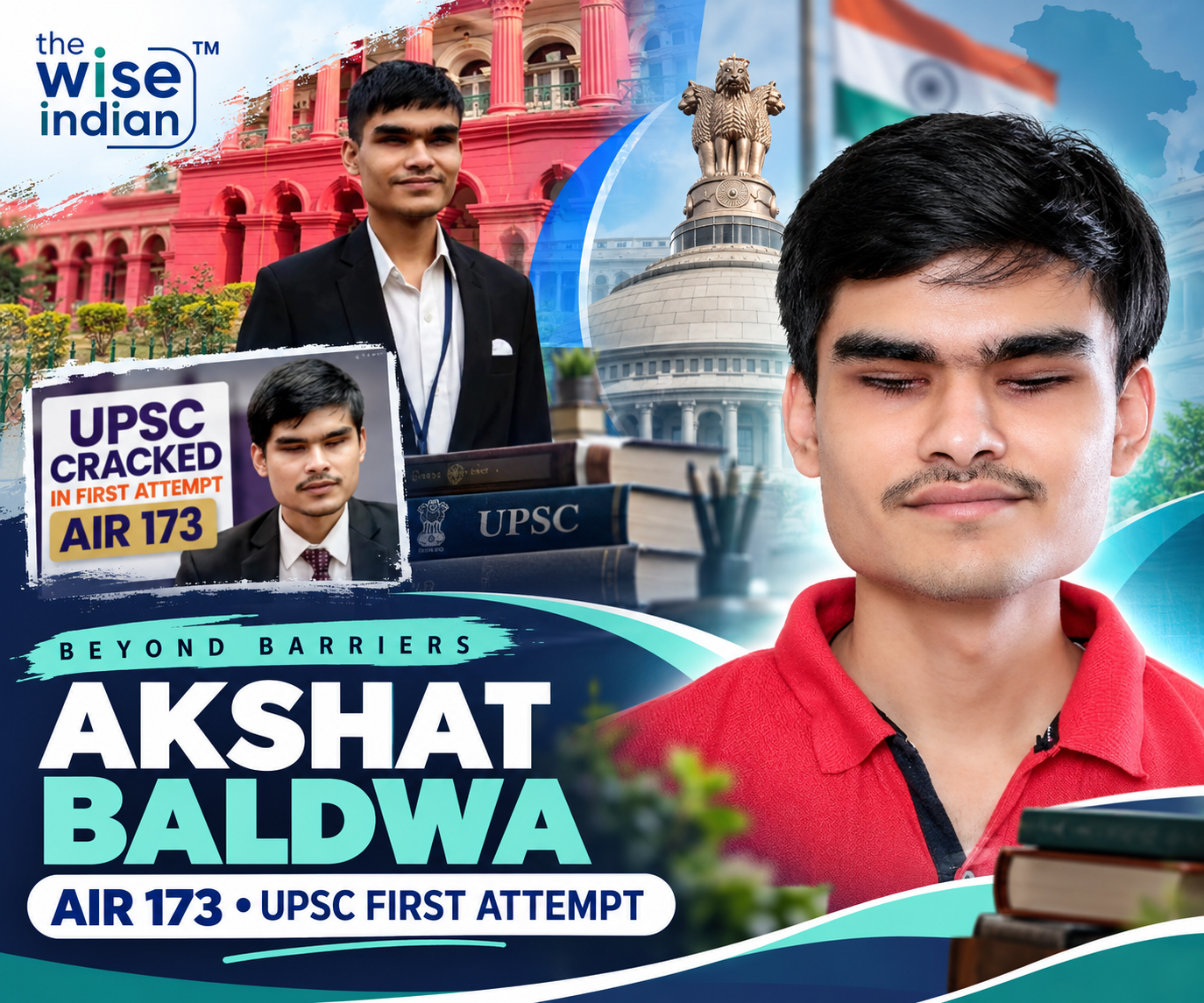
A visually impaired law graduate from Indore has achieved a remarkable milestone in India’s most demanding competitive examination. Akshat Baldwa secured All India Rank 173 in the Civil Services Examination 2025, clearing it on his first attempt. Yet, his journey reaches far beyond a prestigious UPSC result. Before this achievement, he had already approached the courts to demand accessible cinema for people with disabilities. His story brings together education, persistence and a determination to make public spaces more inclusive.
Akshat Baldwa: From Indore to a National Achievement
Akshat Baldwa, a 25-year-old from Indore, has been blind since early childhood. He completed Classes 11 and 12 in Hindi medium at Government Subhash Higher Secondary School. Later, he moved to Bengaluru and joined the National Law School of India University (NLSIU). There, he completed the five-year BA LLB (Honours) programme in 2025. His academic journey required him to navigate a demanding course while using accessible learning methods and technology. He improved his English and chose it for both preliminary and mains examinations. Moreover, his success came while balancing law school commitments with preparation for the civil services.
Akshat Baldwa’s UPSC Preparation: Online Resources and Focus
Akshat began preparing for UPSC during the fifth year of law school. With limited time, he chose a focused strategy instead of trying to read every standard textbook from cover to cover. In his interview with Bar and Bench, he said he relied heavily on previous-year question papers and mock tests. He used online materials available through Telegram and other platforms. He also used artificial intelligence in his academic work and examination preparation. For the preliminary examination, he attempted around 40 to 50 mock tests during the final two or three months. He had coaching access but relied mainly on independent study.
After clearing prelims, he had approximately 70 days to prepare for the mains. Therefore, he practised answer writing with a peer group. Five friends also conducted mock interviews together before the personality test. The mains examination brought a distinct challenge. Akshat told the Times of India that writing continuously for nearly four hours was difficult, but he remained focused. As a visually impaired candidate, he used a scribe for the written examination. Accessible examination support enables candidates to demonstrate their knowledge. It does not replace their preparation, judgement or effort.
From Legal Advocacy to Accessible Cinema
Akshat’s work for inclusion began before his UPSC success. While studying at NLSIU, he joined other petitioners in legal action. They sought better film access for people with visual and hearing impairments. The issue was straightforward but significant: a film can remain inaccessible when audiences cannot access its visual or audio information. Audio description helps visually impaired viewers follow important visual details. It uses spoken narration to explain actions, expressions, scene changes and other information that dialogue alone may not communicate.
Meanwhile, subtitles and closed captions help people with hearing impairments follow spoken dialogue and relevant sounds. These features allow more people to experience the same story. One major case concerned the Hindi film Pathaan. In January 2023, the Delhi High Court considered a petition about Pathaan. It sought audio description, subtitles and closed captions for the film’s OTT release. The court directed the producer to prepare these features and submit them for certification. The wider case also raised the need for consistent accessibility standards across films and broadcasting.
In January 2024, the court called for stakeholder consultation involving film producers, OTT platforms, broadcasters, theatre owners and disability organisations. Section 42 addresses accessible formats and access to electronic media through features such as audio description and captioning. Akshat later told NLSIU that legal intervention could bring change. He cited cases involving Yash Raj Films and Maddock Pictures.
Why Akshat Baldwa Chose the Civil Services
Akshat Baldwa’s motivation grew from what he observed within the blind community. He had seen many blind people enter a limited range of careers. These included bank clerical roles, railway jobs and Group D services. He wanted to pursue a different path and contribute to society on a wider scale. His law education also showed him the gap between rights written in legislation and rights people can actually access. For him, civil services offered an opportunity to work on both policy and implementation. He has expressed interest in disability issues, the concerns of slum dwellers and other marginalised communities.
His legal work and career ambition share one concern. Both seek to make institutions work for people who are often left out. His decision also involved personal risk. Akshat Baldwa chose not to participate in campus placements because he wanted to pursue his long-standing civil services ambition. After graduating, he faced the pressure of finding employment and supporting his family. The goal had stayed with him since Class 11. His parents, Sanjay and Meena Baldwa, supported him throughout his education and preparation.
The Wise Take
Akshat Baldwa’s AIR 173 is an impressive result. However, the wider meaning of his journey lies in what came before it. He pursued a demanding law degree, prepared for UPSC alongside his studies and used accessible tools to compete. At the same time, he worked through the legal system to make films more inclusive. His experience shows that accessibility is not a favour; it is a way to make equal participation possible.
A scribe, accessible study resources and suitable technology helped him take part in the examination. However, the discipline, preparation and answers remained his own. For students facing barriers, his journey offers a powerful reminder. Circumstances can shape the route, but they need not decide the destination.
Also read our other article on How Aaliya Mir Traded a Maths Classroom for Kashmir’s Wildlife Rescues and Taught Villagers to Coexist With Wild Animals
Follow The Wise Indian for more inspiring stories.