
When a leopard strays into a Kashmir village, panic spreads quickly. Aaliya Mir moves towards the problem instead. Based in Srinagar, she rescues wild animals and teaches people to live beside them. Moreover, her journey shows how a changed path can protect an entire valley.
Aaliya Mir: A Maths Teacher Who Chose Wildlife
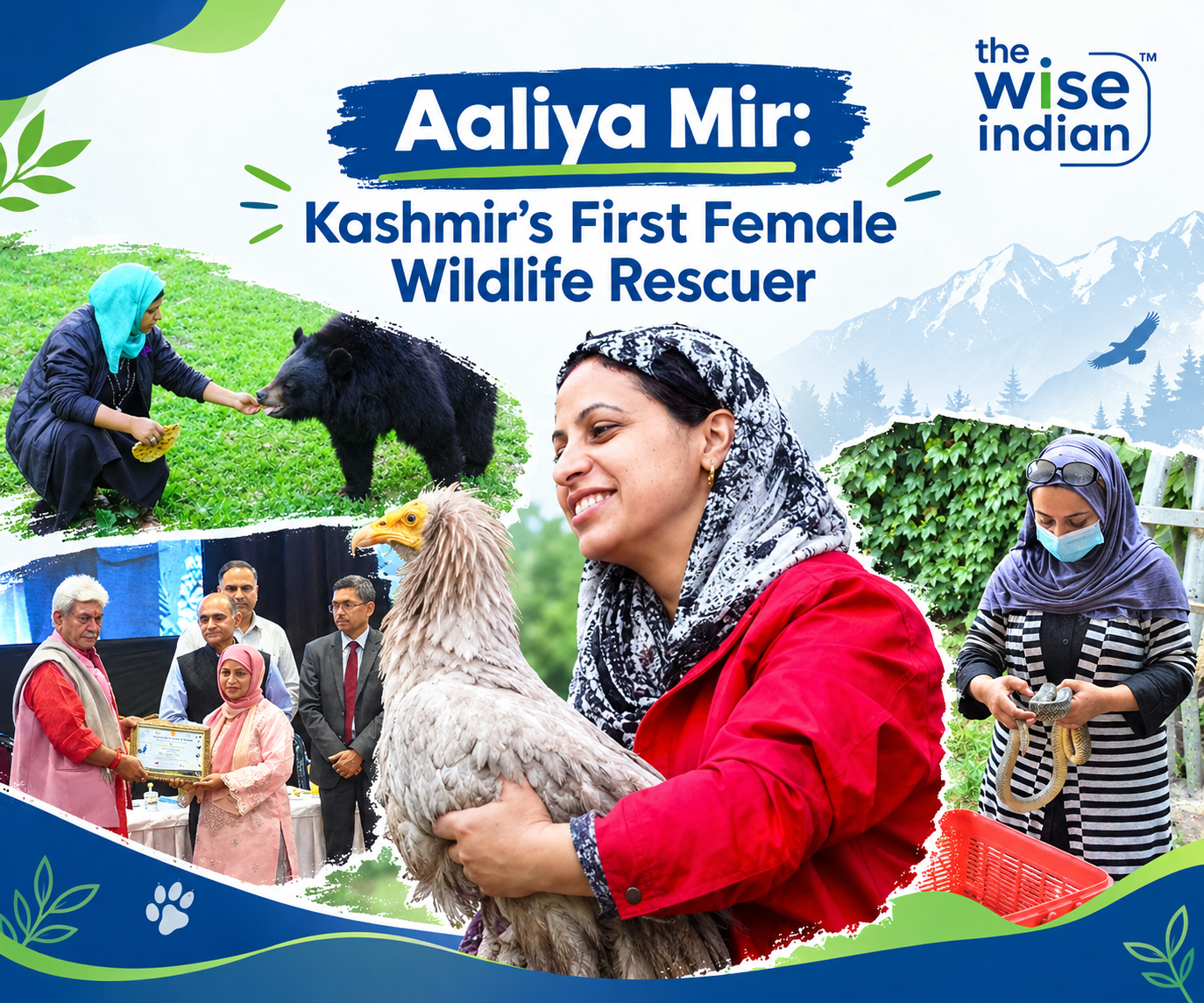
Aaliya Mir never planned to become a wildlife rescuer. She aspired to teach, so she studied mathematics. In 2002, she married veterinarian Dr Shabir Ahmed while studying in Delhi. That is when she began volunteering with Wildlife SOS, a non-profit that rescues and rehabilitates wild animals. Her association with the organisation now spans more than two decades. Today, she leads Wildlife SOS work in Jammu & Kashmir as Project Head and Education Officer.
In March 2023, the Jammu & Kashmir government honoured her on International Day of Forests. Lt Governor Manoj Sinha presented the award. Furthermore, she became the first woman from the region to receive such a wildlife award. The honour recognised efforts across rescue, research and education. Many outlets describe her as Kashmir’s first female wildlife rescuer. Videos of her rescues went viral, and she became a household name in the valley. In them, she climbs ladders in Kashmiri homes to catch snakes, wearing sports shoes and a hijab. Her husband feels proud, although he admits the work can feel terrifying. Meanwhile, she keeps learning through courses on rescue and animal behaviour.
One Tragic Incident Changed Aaliya Mir Direction
The turning point came in 2007. That year, a bear was stoned in a Kashmir village. Human-animal conflict was already rising across the region. The incident pushed Wildlife SOS to start a project reducing such conflict in Jammu & Kashmir. As a result, Aaliya became project manager and headed operations there. Mobs were another challenge. Earlier, hundreds of people would gather around a spotted animal with sticks and axes. They often drove it away by stoning or hitting it. Aaliya’s team counts controlling those crowds among its biggest achievements.
Moreover, her team now trains frontline staff in mob management. Together with the Jammu & Kashmir wildlife department, they respond to rescue calls. In May 2021, Wildlife SOS also launched a rescue helpline. Habitat loss fuels the problem. Aaliya explains that buffer land between villages and forests has largely vanished. Consequently, prey becomes scarce, so leopards turn to livestock. Retaliation then follows, and the cycle continues.
Rescue Calls, Snakes and Leopards
Aaliya Mir’s phone rarely rests. Reports say she handles about five rescue calls daily, sometimes more. Callers include locals, the wildlife department and the police control room. Besides, snake rescues rise each summer. She has pulled snakes from kitchens, gardens and even toilets. Likewise, she has rescued venomous Levantine vipers. Her team has rescued many species too. In the three years before 2021, they saved 88 reptiles, 16 raptors, three bears and two leopards. They also rescued six monkeys and two turtles. Snowfall once complicated a rescue, yet her team helped release the animal in its natural habitat.
Beyond rescues, she supervises projects studying Kashmir’s brown and black bears. She also joined the Hangul census and the Asian Waterbird Census. Her toughest rescue involved a mother bear and two cubs in an abandoned Pulwama house. The mother ran off after a tranquiliser dart. Meanwhile, the team kept the cubs safe in a cage. After dark, the mother returned. Finally, the team reunited the family and freed them in the wild. Some bear cubs lose their mothers in conflicts. Aaliya manages the Dachigam and Pahalgam bear rescue centres for such cubs. In 2023, those centres housed six Asiatic black bears and two Himalayan brown bears.
Teaching Schools to Live Beside Wildlife
Rescue is only half her job. She says awareness runs parallel to every rescue. As Education Officer, she runs programmes in schools, colleges and villages. These workshops explain how to stay safe around wild animals. Moreover, she runs sessions for law enforcement agencies and forest departments. She even reaches tribesmen living in forests. Her team also shares pictorial flyers with leopard safety instructions. She has also taken students bird-watching at Dachigam National Park.
Her advice is practical. If a leopard is nearby, keep pets indoors. Children and the elderly should stay inside from dusk to dawn. Likewise, avoid lonely shortcuts through villages and forests. For bears, keep dustbins inside, because garbage attracts them. Furthermore, cement poultry pens, since mud pens are easy to break into. Bells on livestock also work as an alarm. Finally, victims can claim compensation from the wildlife department for injuries. Ignorance still surprises her. At one college session, a professor blamed her team for a tiger in Lal Chowk. Aaliya explained that Kashmir has no tigers, only leopards.
The Wise Take
The numbers explain why her work matters. Mongabay India reports official figures of 242 deaths and 3,528 injuries from conflict between 2006 and 2020. Besides, 44 leopards and 124 black bears died from retaliation or natural causes between 2012 and 2020. In 2022, the wildlife department’s Central Division reported at least 131 incidents. Clearly, awareness matters as much as rescue.
Aaliya’s journey proves that a detour can lead to greater purpose. She wanted to teach, and she still does. Her classroom now includes entire communities. Moreover, she sees changing attitudes as her key challenge and trusts young people to help. Rescues save single animals, yet awareness protects many more. Aaliya Mir believes humans and animals must learn to share the same land. Respect for the wild keeps both people and animals safe. Therefore, call trained rescuers instead of crowding around a wild animal.
Also read our other article on Ratan Tata Death Anniversary: How a Boy Raised by His Grandmother Led the Tata Group and Won India’s Heart
Follow The Wise Indian for more inspiring stories.