

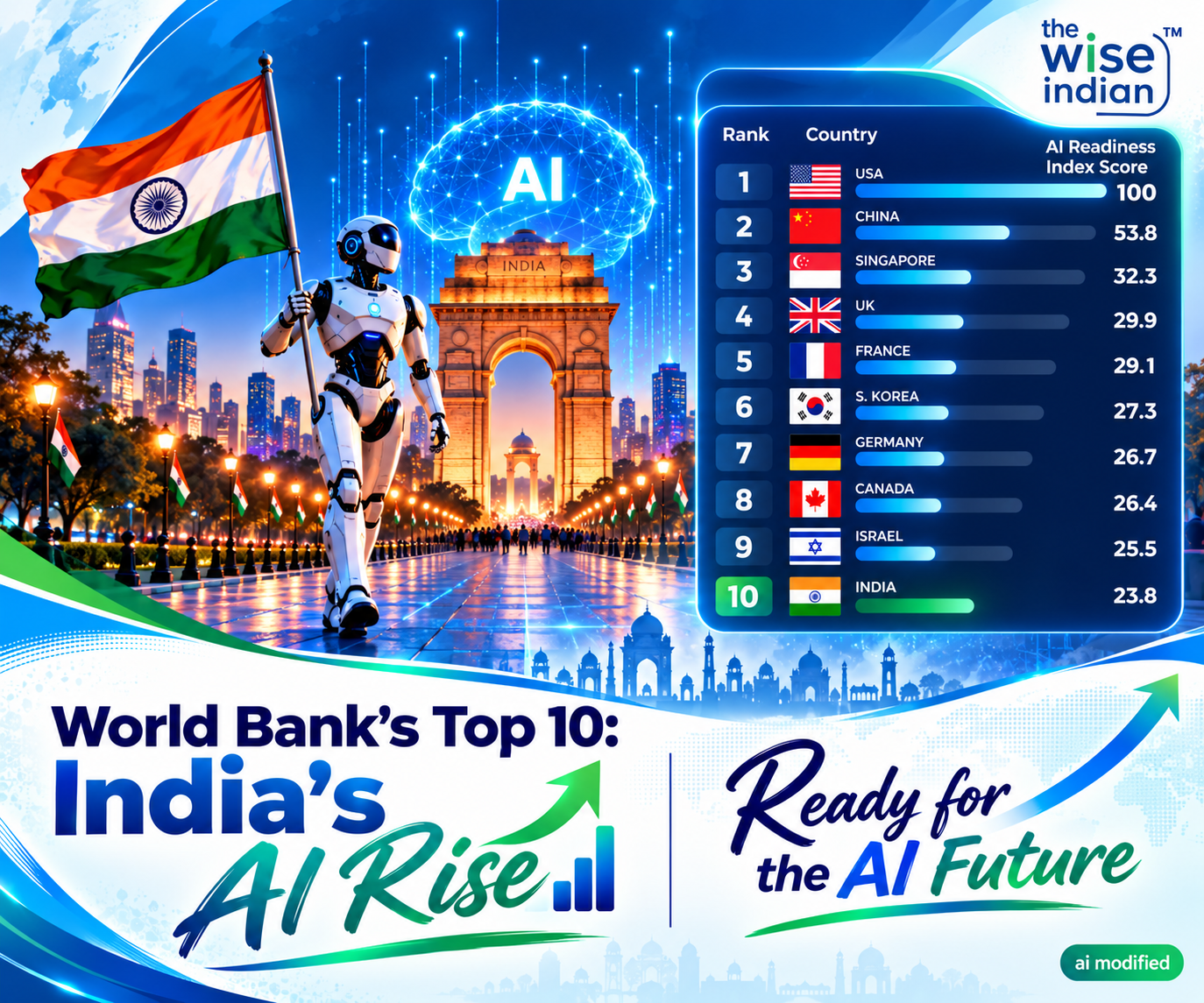
India AI readiness has earned a major global endorsement. The World Bank has ranked India among the top 10 emerging-market performers in artificial intelligence readiness. The bank released the report on 6 October 2026. However, the bank also warns that the long-term impact of AI remains uncertain.
What the World Bank Says About India AI Readiness
India AI readiness sits at the heart of a new World Bank report. The report is titled India and Artificial Intelligence: Seizing the Development Opportunity. It forms part of the India Development Update. AI readiness measures how prepared a country is to use AI well. Talent, infrastructure, investment, and policy all play a part. Countries that score high can adopt new tools faster. According to the bank, India is one of the top 10 leading emerging-market performers on AI readiness.
Three strengths drive this position. India has a large technical workforce. Its IT sector connects closely with global markets. Moreover, its digital public infrastructure gives AI tools a strong base to build on. Paul Procee, the World Bank’s Acting Country Director for India, shared a clear view. He said using AI as a development tool, not only a technology, could be among India’s strongest levers. In particular, it could lift productivity and improve public services. The report also refers to a related World Bank paper, Beyond the AI Divide. That paper studies the gaps in AI readiness between countries. It also offers a simple way to spot overachievers.
The Numbers Behind the Ranking
The numbers explain why the ranking matters. First, private investment in AI more than tripled. It rose from $1.2 billion in 2024 to $4.1 billion in 2025. The ranking arrives as India’s AI ecosystem draws record private investment. Next, employment at Global Capability Centres (GCCs) also climbed. Professionals employed there grew from 1.9 million in 2024 to 2.36 million in 2025. GCCs are offshore units that serve global companies. Their growth shows rising demand for digital skills.
Therefore, the AI boom is clearly opening new doors for skilled workers. These gains did not appear overnight. Years of investment in digital systems and technical skills laid the groundwork. As a result, India enters the AI race with a solid base. NDTV’s report adds context to that investment figure. It placed India sixth in the dataset, behind the United States, China, the United Kingdom, France, and Canada. However, India stayed ahead of Germany, Israel, and Australia.
Why India AI Readiness Stands Out Among Emerging Markets
This position rests on several strengths working together. First, the country has a huge pool of engineers and IT professionals. Second, its IT sector already serves clients across the world. Third, digital public infrastructure reaches millions of people. Each strength supports the others. The World Bank says these strengths set India apart from most emerging economies.
Together, these pieces give AI tools both talent and reach. India’s digital public infrastructure deserves special mention. It gives citizens easy access to services through simple digital tools. As a result, AI can plug into systems that people already use. The World Bank also sees AI as a way to improve public services. This is not India’s first strong showing. In 2022, the Oxford Insights AI Readiness Index ranked India 32nd among 181 nations. That marked a jump of 19 places. Moreover, the Network Readiness Index 2022 placed India first for AI talent concentration. Clearly, these strengths took years to build.
Challenges the Report Asks India to Address
However, the World Bank does not offer only praise. It says the long-term effect of AI on jobs and the economy remains uncertain. Therefore, India must act with care. Adoption also remains low. Data from April 2025 show only 4 percent of Indian internet users reported using ChatGPT. In the United States and South Korea, that figure was 29 percent. Brazil, Vietnam, and Mexico also scored higher. Therefore, readiness must now turn into everyday use.
The bank suggests several steps. India should expand AI use beyond large urban firms. It should also build worker skills and strengthen AI-enabling infrastructure. In addition, the government can use AI to improve public services. Finally, flexible rules should guide how the technology grows. AI-enabling infrastructure usually means reliable connectivity, computing power, and quality data. Without these basics, even skilled teams struggle to build useful tools. Therefore, steady investment in them matters as much as new ideas. Workers need attention too. Many jobs may change as AI tools spread.
For that reason, training programmes should help people learn new skills early. A smooth transition protects both livelihoods and growth. Small businesses also need easier access to AI tools. At the same time, strong data security must remain a priority. Meanwhile, the World Bank Group is backing “small AI” through AgriConnect. These tools are targeted and locally adapted. They aim to spread benefits widely and support workers during the transition.
The Wise Take
India AI readiness now carries a strong global stamp of approval. The ranking shows that talent, investment, and digital systems work well together. Yet a ranking alone does not guarantee success. India must still train workers, protect data, and help small businesses adopt AI. If it does, the benefits can reach farmers, students, and shopkeepers.
Therefore, this report should inspire both confidence and careful action. Overall, India has the talent, the money, and the digital base. What it needs now is steady execution. For young Indians, the message is simple. Learning basic AI skills today can open many doors tomorrow. Keep learning, because AI skills will matter in almost every field.
Also read our other article on India Hit Its Lakhpati Didi Target and Doubled It. A Lakhpati Didi’s Household Lives on Rs 8,333 a Month
Follow The Wise Indian for more technology-related information, insights, and daily updates on India’s tech landscape



