

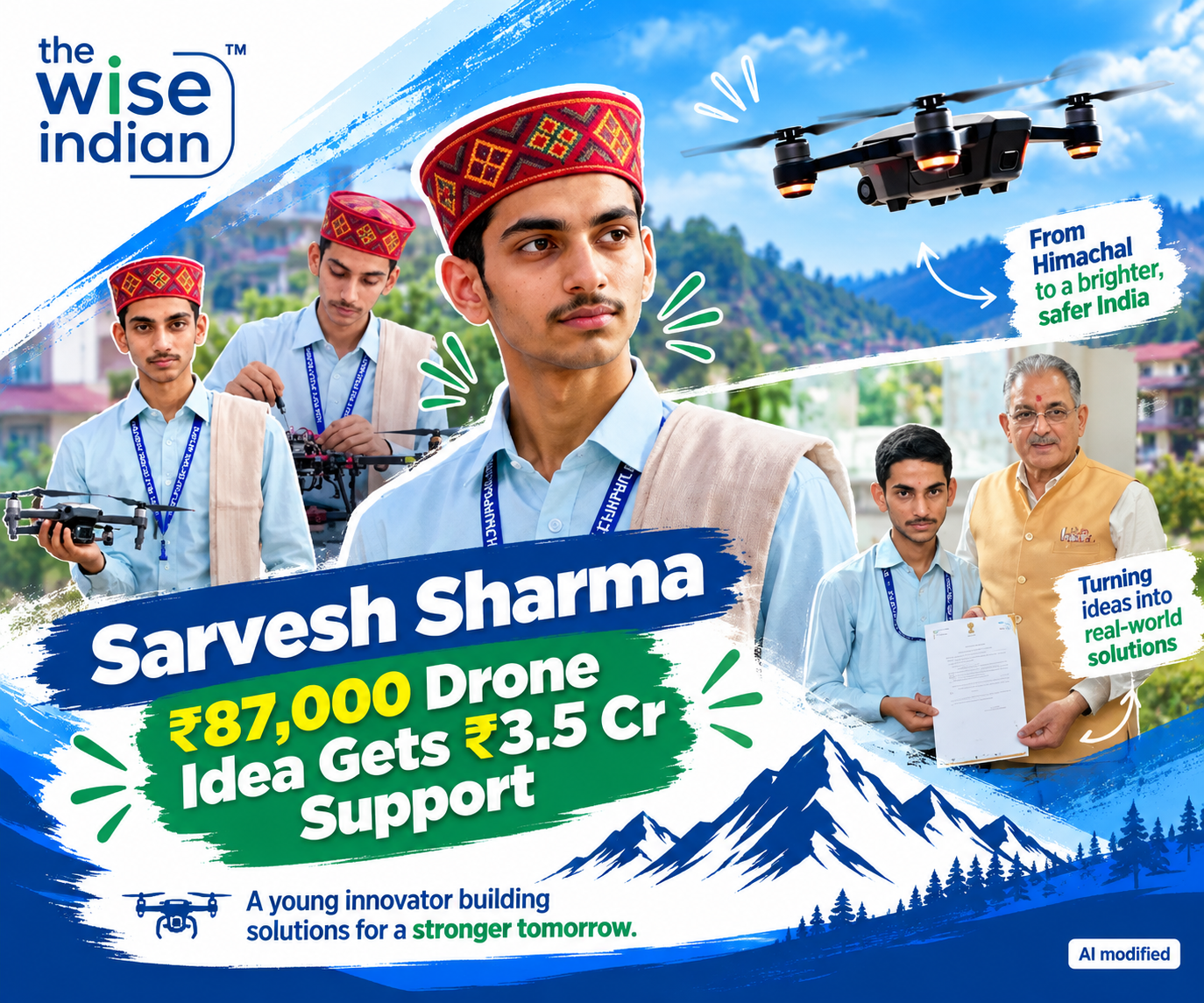
In a village in Himachal Pradesh, a daily-wage labourer’s son has caught the Defence Ministry’s attention. Sarvesh Sharma, a polytechnic student, has won a ₹3.5 crore grant to build an Army drone. The project began with just ₹87,000. His story shows how far talent can travel.
Who Is Sarvesh Sharma?
Sarvesh Sharma is a fifth-semester student at Government Polytechnic College, Hamirpur. He comes from Bahanvi village in Himachal Pradesh. The Tribune reports that he studied at a government school in his village. His father is a daily-wage labourer. His mother is a homemaker. The report describes the family as low-income. Global Education News notes that his route did not begin at a major engineering institute. Few would have guessed that a link to India’s defence sector lay ahead. Yet Sarvesh kept developing his idea after a college contest ended. That quiet persistence is the real start of this story. Talent needs a stage, and he soon found one.
How a Cardboard Drone Contest Changed Everything
The turning point came at the Open Cardboard Drone Competition. IIT Jodhpur and the Konark Corps organised the national-level event. Around 50 teams from premier institutions across India took part. Sarvesh secured fourth position and won a prize of ₹10 lakh, he told The Tribune. Sarvesh said the event sharpened his focus on troops posted in high-altitude border regions. ETV Bharat carried his comments, Economic Times Defence reports. He added that the contest was about finding a real military challenge, not only ranking. That shift turned a student project into a proposal with government backing. The project had initially cost ₹87,000, according to The Tribune.
Economic Times Defence says that sum covered the prototype and his proposal. Moneycontrol adds that he built the early prototype with limited personal resources. That is a small sum for any defence-related project. Sarvesh then applied for a start-up project under the Defence Innovation Organisation and iDEX. iDEX stands for Innovations for Defence Excellence. It backs young innovators and start-ups in the defence sector. The Ministry of Defence approved his project with a grant of ₹3.5 crore. The college principal says the approval came from Dinesh Mahaur of the Department of Defence Production. The principal says the achievement has brought pride to the family, the college and the state. The head of the Computer Engineering Department, Sameer Bharti, and the staff also congratulated him.
What Is the Rudra Edge T-1 Drone?
The drone is called Rudra Edge T-1 (Spectra). It is meant for border surveillance by the Indian Army. Reports say it is designed to evade enemy radar detection. It is also meant to resist jamming attempts. Global Education News says it targets challenging border and high-altitude environments. The project aims at a practical problem, not a showpiece prototype. In mountains, conventional drones can struggle with thin air, long distances and hostile electronic conditions.
Economic Times Defence says weather and communications conditions also make surveillance difficult and expensive. Drones for such terrain must balance endurance, detection resistance, communication stability and cost. These are design goals, not proven results. Moneycontrol says they should not be treated as confirmed performance specifications. Economic Times Defence notes that stealth claims only matter once a system survives field trials. The project is therefore a work in progress.
From Hamirpur to IIT Roorkee: What Comes Next
An incubation centre for the project has been set up at IIT Roorkee. Moneycontrol says it will give him laboratories and professional mentorship. The target for completion is 20 months. Economic Times Defence calls the shift from a village school to an IIT incubator unusually steep. Governor Kavinder Gupta felicitated Sarvesh Sharma on 23 September. He said the achievement reflects the untapped talent and technological potential of Himachal’s youth. The Governor urged young people to pursue innovation, research and entrepreneurship. He also said they should aim to become job creators, not only job seekers.
The project sits where student engineering meets military procurement, as Economic Times Defence puts it. Indigenous solutions can reduce dependence on imported systems, it adds. If the drone succeeds, it could strengthen the case for more student-led defence projects. Even if it falls short, it shows small teams from modest backgrounds can enter this field. The coming months will test the project. Moving from a prototype to a validated defence system is difficult. Sarvesh will need patience, teamwork, and steady testing.
The Wise Take
Sarvesh Sharma’s journey proves that background does not decide how far a student can go. He did not study at a famous engineering institute. He learned in a government polytechnic and built on a small budget. Then he entered a contest, and the contest opened a door. His drone is still under development. Its radar and jamming goals must still pass real tests. That honest truth makes the story stronger, not weaker. The real lesson is about starting before you feel ready. Small budgets, government schools, and village roots are not barriers. They can be the beginning of national work. For students across India, the message is clear. Enter the contest, build the prototype, and keep improving. Opportunity often follows people who keep showing up.
Also read our other article on UP Scholarship 2026-27: Critical Application Deadlines Open for UG, PG, Diploma, and ITI College Students in Uttar Pradesh
Follow The Wise Indian for more inspiring stories.



