

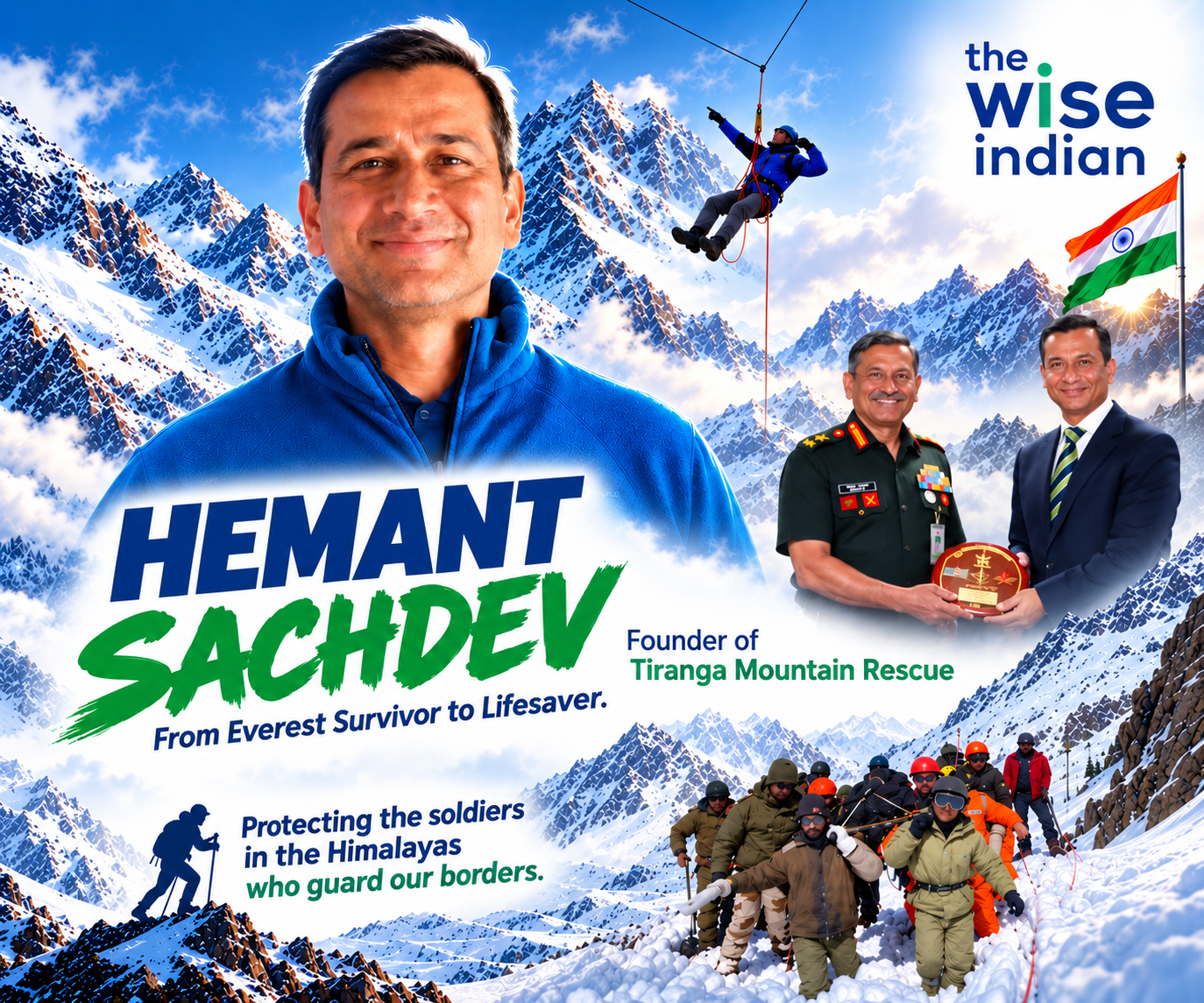
In 2013, Hemant Sachdev was crossing the Khumbu Icefall on Mount Everest when the ground gave way. He fell. A rope held. A teammate pulled him out. About a week later, on 19 May 2013, he stood on the summit. That fall never left him. Three years later, he founded Tiranga Mountain Rescue, a non-profit that now trains Indian Army soldiers to survive avalanches. It began with three teams and fifteen people.
The Fall in the Khumbu Icefall
Sachdev grew up in Delhi. He studied at Modern School, Barakhamba, then Delhi University, and later at Harvard Business School. His career ran through Bharti Airtel and Bharti Enterprises, where he worked as a brand and marketing executive. He then became an entrepreneur. In 2000, he started Chogori, an outdoor gear company, from his own basement. He was also behind bringing Crocs and Columbia to India. Even then, the mountains pulled at him. Climbing was not a hobby he squeezed between jobs. It was the thing he kept returning to.
Then came 2013. The Khumbu Icefall sits just above Everest Base Camp. It shifts constantly, and climbers cross it on ladders and ropes. Sachdev fell into a crevasse. Reports differ slightly on the ropes involved, but both agree on the core. One line failed him, a second held, and a teammate hauled him out. He kept climbing. About a week later, he reached the top. “If you don’t have a great structure or a good sense of very skilled people to provide you safety, to ensure your safety, then you can never really achieve great heights,” he later said.
Tiranga Mountain Rescue and the Indian Army
That sentence became his plan. In 2016, Sachdev founded Tiranga Mountain Rescue. The same year, it signed its first agreement with the Army’s Northern Command, placing rescue teams in avalanche-prone terrain. Soldiers train and operate in the world’s highest mountains. Civilian rescuers who live in those mountains could stand beside them. The Defence Minister’s office later described TMR as “a non-profit organisation affiliated with the Indian Army since 2016.”
The partnership grew. Eastern and Central Commands signed on in 2021 and 2024. Then, in September 2024, the Army signed a service-wide agreement at the Centre for Land Warfare Studies in Delhi. Major General Manish Luthra signed for the Army, Sachdev for TMR. Army Chief General Upendra Dwivedi was present. Soldiers enter the mountains because it is their duty. TMR’s rescuers go because they choose to. Sachdev has drawn that line himself. “We do it out of passion,” he said. “They do it out of duty, and are still left to face these circumstances.”
What the Tiranga Mountain Rescue Team Actually Do on the Mountain
Tiranga Mountain Rescue sends trained teams into snowbound sectors through the winter. Reporting describes them working from Siachen to Kargil, Tawang and Gurez. Each team carries specialist search-and-rescue equipment. Their work runs in two directions. First, they train. TMR says it has coached more than 20,000 Army personnel in avalanche awareness, mountain survival and emergency response over roughly a decade. Second, they deploy. When a snowslide buries a post or a patrol goes missing, these teams dig.
Those teams now number 16, according to The Better India. The same reporting says they visit more than 200 high-altitude posts each winter. A civilian rescue crew working permanently alongside soldiers, in the same conditions, is not a common arrangement anywhere.
What Has Changed on the Ground
The results are harder to measure than the headlines suggest. TMR says its work has helped save around 400 soldiers. That figure is the organisation’s own, and no public register or audit supports it. Some missions end differently. In 2022, seven soldiers were buried by an avalanche near Tawang in Arunachal Pradesh. According to reports, Army teams searched for two days without finding them. A TMR team was then flown in, and within hours of landing it located all seven. None had survived.
What TMR returned was closure; the soldiers could be brought home, and their units and families finally had an answer. Reporting says avalanche casualties fell from 38 in 2017 to near zero by 2023-24 in the areas where TMR operates. “In the last three years, casualties have come down to zero,” Sachdev told the Times of India in July 2026. “The most dangerous place in the mountains is only as dangerous as your ability to rescue.” The Army has recognised the work too. In 2024, two TMR team members received Chief of Army Staff Commendation Cards.
The Wise Take
Hemant Sachdev did not build Tiranga Mountain Rescue from a boardroom. He built it from a fall. A rope held him that day, so he spent years making sure other ropes would hold for people he would never meet. There is a quiet lesson in that. Most of us move on from our bad days. He turned his into a system. The soldiers who walk into the snow each winter may never know his name. The chance that they come back has changed because of him.
Also read our other article on Lobzang Yangchen: The Spiti Woman Leading an 11-Member Team in India’s Snow Leopard Survey
Follow The Wise Indian for more stories about the changemakers and quiet builders reshaping India. From an app that took India’s labour chowks online to a Himalayan rescue service that stands beside the Army, we bring you the stories that deserve to be told.



