

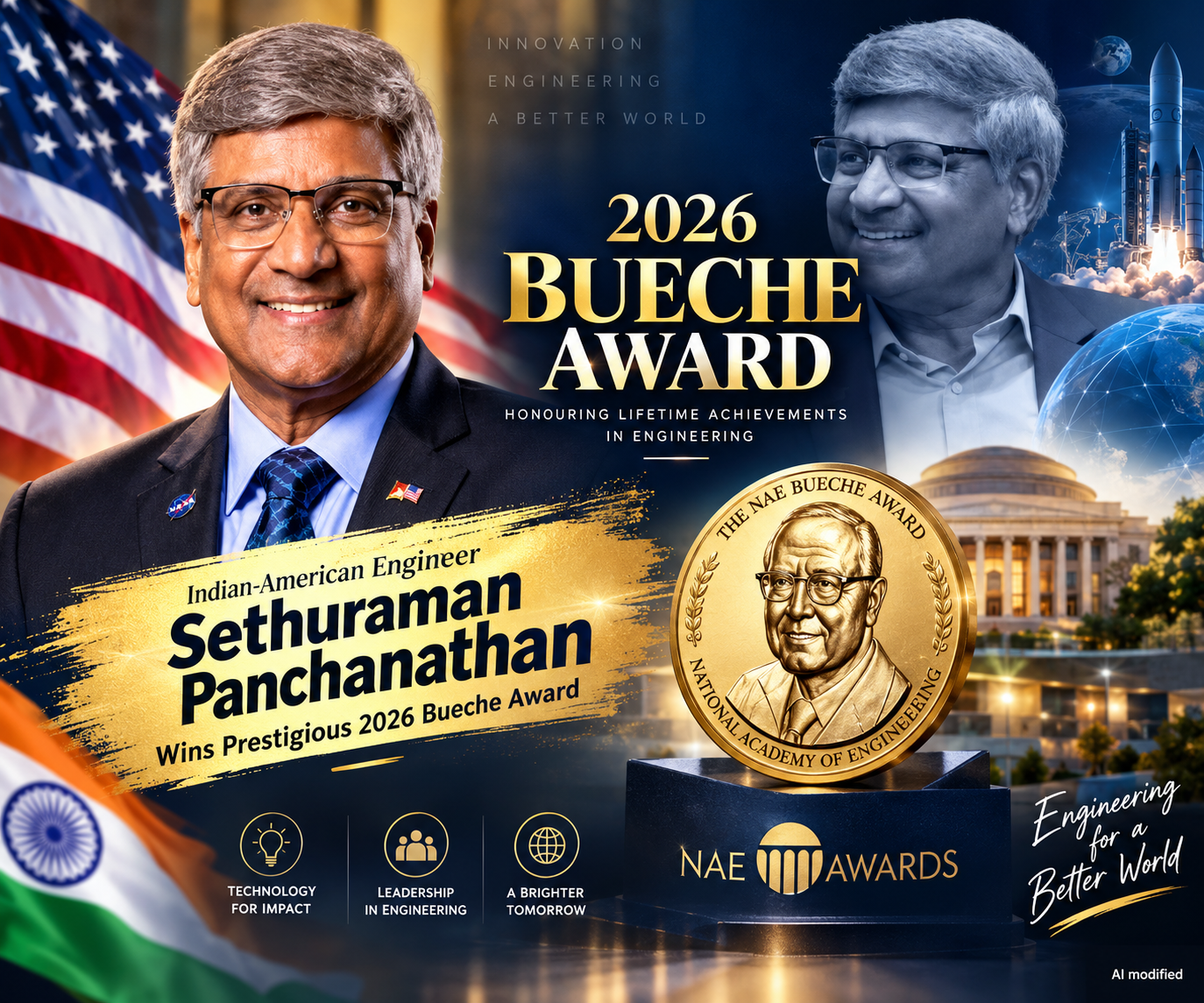
Sethuraman Panchanathan grew up in Chennai, and a single childhood sight shaped everything that followed. He saw the rocks brought back from the Moon by Apollo 11. The rocks did not impress him much. The human effort behind them did. On 4 October 2026, that childhood wonder reached a new peak. In Washington, DC, Panchanathan became the first Indian American to receive the Arthur M. Bueche Award from the United States National Academy of Engineering. The honour has existed for more than 40 years. Until now, nobody of Indian origin had won it. He earned it across four decades of steady work.
A Chennai Boyhood and a Case of Moon Rocks
Panchanathan was born on 24 June 1961 and grew up in Chennai. Apollo 11 had landed in 1969, when he was eight, and a public display of its moon rocks left a deep mark. The stones themselves were ordinary. The story behind them was not. “The rocks were just rocks,” he later recalled. “But what fascinated me was all the human ingenuity and scientific prowess that went into bringing them here.” That early wonder turned into a clear plan. Sethuraman Panchanathan studied science first, then moved into engineering.
He earned a BSc in Physics from the University of Madras in 1981. He also followed it with a BE in Electronics and Communication Engineering from the Indian Institute of Science in 1984. Two years later, he completed an MTech in Electrical Engineering at IIT Madras. In 1989, he finished his PhD at the University of Ottawa in Canada. His Indian training carried him across the world, but the questions he asked began at home.
Five Years Leading American Science
That rise took him to one of the most powerful science jobs in the world. In December 2019, President Donald Trump nominated him to lead the US National Science Foundation. The Senate confirmed him on 18 June 2020. He served as the agency’s 15th director until April 2025. The role meant steering a body that funds research across American universities. He used it to speak about access. Talent, he argued, is spread evenly across the world. Opportunity is not. His own record supports that case. The NSF credits him with four patents and more than 485 published papers. He has also mentored more than 150 students, researchers and scientists. Today he is a University Professor of Technology and Innovation at Arizona State University. In April 2026, the city of Phoenix asked him to lead its new quantum strategy.
Why the Bueche Award Went to Sethuraman Panchanathan
The Arthur M. Bueche Award rewards a specific kind of engineer. It honours people with active involvement in shaping US science and technology policy. It also credits work that strengthens links between industry, government and universities. The academy named Panchanathan its 2026 recipient. He is the first Indian American to win the award in its more than 40-year history. He is the first Arizonan too. The prize was presented at the academy’s annual meeting in Washington, DC, on 4 October 2026. He greeted the news with modesty. “I’m honoured and humbled by this recognition,” he said. Then he turned the credit outward. “Awards like this are never only about the individual,” he said. “They are about the scores of people that have contributed to the outcomes recognized.”
The Indian Honour He Received in 2025
Recognition at home arrived a year earlier. President Droupadi Murmu conferred the Padma Shri on him on 27 May 2025. IIT Madras has also named him a Distinguished Alumnus. Those honours trace the same arc. A student from Chennai built a career in the United States, then kept giving back to both countries. The Bueche Award adds a fresh line to that record. It places him among the small group of Indian-born engineers who now shape how nations fund and use science. That group keeps growing. Each new name on it makes the next one easier to imagine.
The Wise Take
Sethuraman Panchanathan began with moon rocks on display and ended up directing the world’s largest science funder. His path held no shortcuts. It ran through degrees earned one step at a time, and through work that served science itself. The Bueche Award is a first for an Indian American. That fact matters beyond one career. It shows that the people who shape global science now come from everywhere. His own words carry the simplest lesson. Big achievements are never held by one pair of hands. They are carried by families, teachers and mentors, and then passed on to the next person.
Also read our other article on Chandrashekhar Mandal Built Digital Labour Chowk: The App Took India’s Labour Chowks Online and Gave Workers Their Dignity
Follow The Wise Indian for more stories about the scientists and quiet achievers making India proud. From a Bihar labour chowk that moved online to a Chennai boy who grew up to lead American science, we bring you the stories that deserve to be told.



