

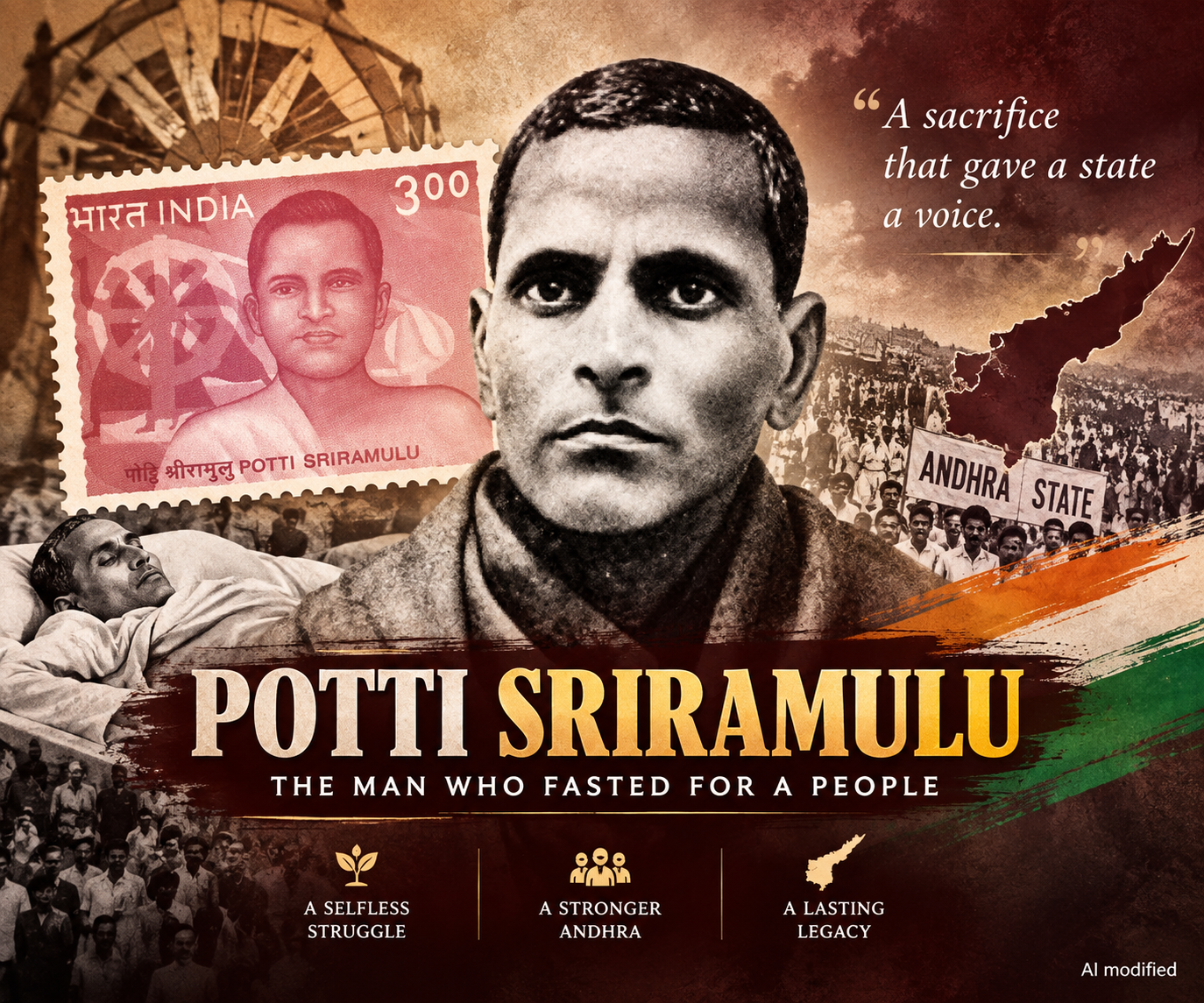
On 1 October 1953, a new state appeared on India’s map. Telugu-speaking districts broke away from Madras State to form Andhra State. India had never before drawn a state along language lines. The Andhra State formation did not happen by choice. It happened after a man fasted to death for it.
The Roots of Andhra State Formation
The demand was older than the man who died for it. As early as 26 May 1913, the first Andhra Conference met in Bapatla. The movement for a separate Telugu state took root there. Telugu speakers lived mostly under Madras State, whose capital was a Tamil-speaking city. Consequently, many felt the government ignored their language and their schools. Through the 1940s, the demand grew louder.
However, it also met firm resistance. In 1949, a committee of Jawaharlal Nehru, Vallabhbhai Patel and Pattabhi Sitaramayya examined redrawing state borders along language lines. It rejected the idea for the time being. Nehru repeated that view in Parliament on 22 May 1952. “Personally, I would look upon anything that did not help this process of consolidation as undesirable,” he said. He added that when the right time came, linguistic states could follow. For Sriramulu, however, that was not soon enough.
Potti Sriramulu’s Earlier Fast for Temple Entry
Potti Sriramulu’s life began on 16 March 1901 in Nellore district. He grew up to become an ardent follower of Gandhi. He joined Gandhi’s ashram, and Gandhi held him in unusual regard. “If only I have 11 more followers like Sriramulu, I will win freedom in a year,” Gandhi reportedly said. Before he ever fasted for a state, he fasted for something smaller and just as hard.
In March 1946, he began a fast demanding entry for Dalits into the Sri Venugopala Swamy Temple in Nellore. It lasted ten days. He won. The temple opened its doors to Dalits. Later that year, he fasted again, for 19 days, to open every temple in Nellore. He returned to the same method in 1948 and 1949, this time asking for a monthly day of service for Dalit uplift. By the time the state question reached him, fasting was not a tactic he had to learn.
The 58-Day Fast for a Telugu-Speaking State
By 1952, Sriramulu had made up his mind. “Now I have come to the conclusion that further work is impossible without an Andhra State,” he said. In September 1952, he wrote a letter that made his intent plain. “I find only one way out,” he wrote. “It is to lay down life with no desire, with no hate and with determination.” On 19 October 1952, in Madras, he began his fast. He demanded a separate state for the Telugu people. It lasted 58 days. Meanwhile, supporters gathered and politicians visited.
The government simply waited for him to stop. He did not. On 15 December 1952, Potti Sriramulu died. He was 51 years old. The news travelled fast. As a result, protests broke out across the Telugu districts. The Better India reports that police firing killed seven people at Anakapalle and Vijayawada. Trains stopped, and crowds destroyed railway property. Four days later, on 19 December 1952, Nehru gave in. He announced that he would create a Telugu-speaking state.
From Andhra State to Andhra Pradesh
Andhra State came into being on 1 October 1953, with Kurnool as its capital. However, Madras city stayed with Madras State, which disappointed many in the movement. The new state was small and provisional. Instead, its real significance lay elsewhere. It proved that linguistic states were possible, and other language groups took note. In December 1953, Nehru appointed the States Reorganisation Commission. It reported in 1955. In November 1956, Parliament passed the States Reorganisation Act. On 1 November 1956, Andhra State merged with the Telugu-speaking areas of Hyderabad State to form Andhra Pradesh. In the end, the Andhra State formation was the first crack in a wall that soon came down.
The Wise Take
Potti Sriramulu did not live to see the state he died for. He never held office, and he never saw Andhra State on a map. Yet he changed India’s internal borders more than most politicians of his time. He took an old method to its end. He had used it before, for Dalits who could not enter temples and he used it again, for a language whose speakers felt shut out of power. In fact, the lesson sits in that order. He fought first for the smallest group in the room. Remember that when we talk about what one person can do.
Also read our other article on Arati Saha: How a Kolkata Girl Who Lost Her Mother at Two Became the First Asian Woman to Swim the English Channel
Follow The Wise Indian for more stories about the people and events that shaped modern India



