

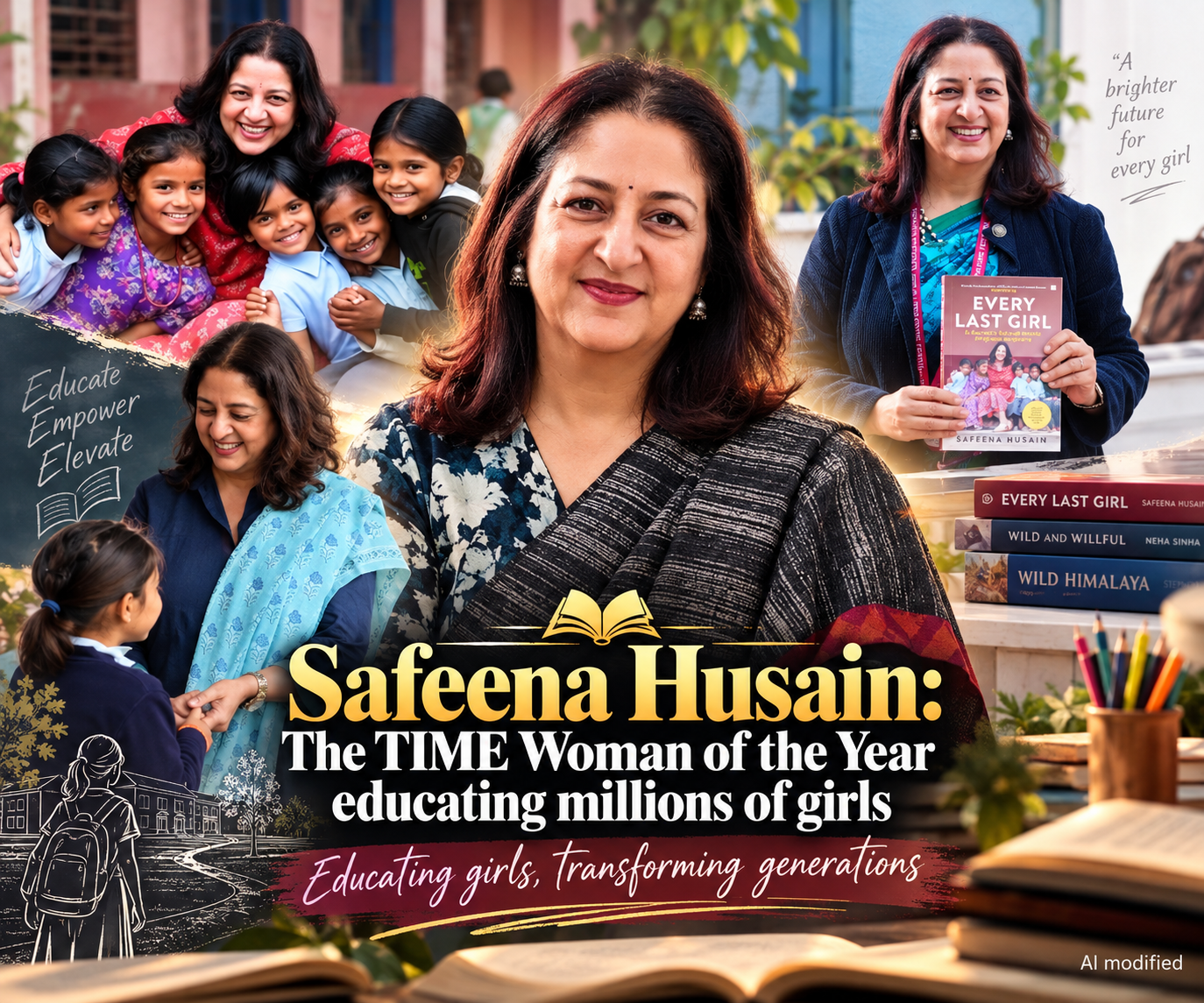
On 7 November 2025, at the Metropolitan Theatre in Manila, an Indian organisation made history. Educate Girls became the first Indian organisation to receive the Ramon Magsaysay Award. Its founder, Safeena Husain, stood on that stage. Behind the honour lay a movement that has carried over two million girls back to school. In fact, it all began with one woman, one state, and fifty villages.
Safeena Husain’s Own Road Back to School
Safeena Husain‘s work flows directly from her own life. She grew up in Delhi. As a young student, she dropped out of school. However, a parent helped her return, and education changed the direction of her life. She later graduated from the London School of Economics.
After that, work took her to Silicon Valley, where she joined a startup. Then came the social sector. She led Child Family Health International, a US-based non-profit, for seven years. Meanwhile, her job carried her to underserved communities in South America, Africa and Asia. In 2007, she finally brought those lessons home. She founded Educate Girls to tackle India’s deep gender gap in education. At first, the organisation’s map covered only fifty villages in Rajasthan.
How Educate Girls Rebuilt the Path to Classrooms
The model is simple and stubborn. Volunteers, called Team Balika, go door to door. First, they find girls who never enrolled or dropped out. Next, they talk to parents, elders and village leaders. Finally, they persuade families that a daughter belongs in a classroom. The organisation says 55,000 young people have served as Team Balika volunteers since it began. Besides door-to-door work, volunteers run Bal Sabhas. These are leadership councils where girls build confidence and life skills.
For example, volunteers also help prepare School Improvement Plans with school committees. Moreover, the method has hard evidence behind it. An independent evaluation by IDinsight studied its learning programme in Madhya Pradesh. As a result, students in the programme gained twice as many assessment points as comparison students after two years. Earlier evidence pointed the same way. Between 2015 and 2018, the organisation took part in a Development Impact Bond for education. An independent evaluation found that children in its schools gained an additional 1.08 learning levels. In other words, they learned 28 per cent more than similar students elsewhere.
The Numbers Behind Educate Girls
The scale has grown steadily year after year. From fifty villages, the organisation now works across more than 30,000 villages. In addition, its reach covers four states: Rajasthan, Uttar Pradesh, Madhya Pradesh and Bihar. Over two million girls have returned to school, according to the organisation. Similarly, its remedial learning programmes have reached more than 2.4 million children. Each figure stands for a register, a classroom, a family convinced. Therefore, when the award jury described the work, it went beyond enrolment numbers. The citation praised the organisation for “liberating them from the bondage of illiteracy.” It also spoke of infusing girls “with skills, courage, and agency.”
Safeena Husain’s Award and What Comes Next
The 67th presentation ceremony drew more than 700 guests to the theatre. Safeena Husain accepted the honour on behalf of her volunteers. “Being the first Indian nonprofit to receive the Ramon Magsaysay Award is a historic moment for Educate Girls and for the country,” she said. She also described how the movement grew. It “began with a single girl in the remotest village,” she said, and then “grew to reshape entire communities.” A day earlier, at a lecture in Manila, she had distilled the problem in one line.
“Even today, we can send rovers to Mars, but not all girls to school,” she said. Meanwhile, the organisation is already looking ahead. It plans to reach ten million learners in the next decade. Husain believes the model will travel beyond India too. As she put it, when one girl is educated, “she takes others with her.”
The Wise Take
Safeena Husain did not start with a grand plan. Instead, she started with fifty villages and a stubborn belief that girls belong in school. Eighteen years on, the world has noticed. After all, the Magsaysay Award honours not a moment but a habit: showing up, door by door, for two decades. Movements rarely begin loudly. Most importantly, they begin where someone decides to start.
Also read our other article on Anchal Bhateja: The Blind Advocate Who Became the First Visually Impaired Woman to argue a case in the Supreme Court
Follow The Wise Indian for more stories about the changemakers quietly reshaping India.



