

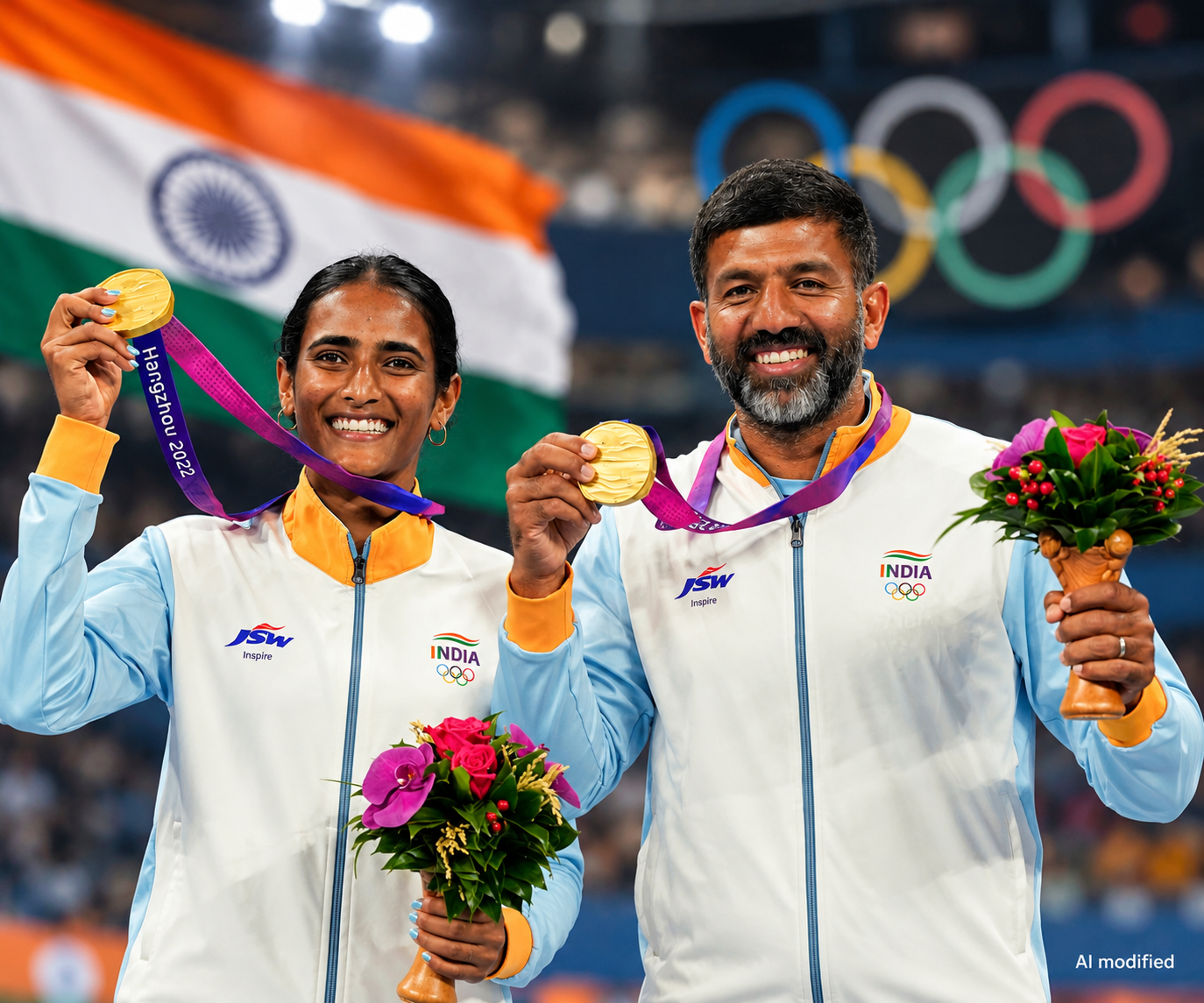
On 30 September 2023, in Hangzhou, India won a tennis gold that few had expected. Rohan Bopanna was 43. His partner, Rutuja Bhosale, was 27. Together they won the Bopanna Asian Games gold in mixed doubles. They beat Chinese Taipei’s Tsung-hao Huang and En-shuo Liang in the final. It was India’s only tennis title at those Games; the men’s doubles pair of Saketh Myneni and Ramkumar Ramanathan took silver. This was a win built on two people, not one.
A Final That Began Badly
India’s pair entered the final as second seeds. The first set did not go to plan. Chinese Taipei broke early and took control. Huang and Liang closed the set 6–2. Bhosale, playing her first Asian Games, struggled with her serve and returns. The occasion weighed on her. “For me to play and stand in front of such a big crowd, it was the first time I’d experienced that,” she later said. “I clearly had some nerves throughout the match, but not on the last point.” Bopanna knew such days well. He had won his first Asian Games gold in 2018 and had said this would be his final Asian Games. He did not want it to end in the first set.
How the Bopanna Asian Games Gold Was Won
Bopanna’s answer was tactical. He asked Bhosale to switch sides when returning. “Today, after we lost the first set, I said, Let’s change sides to return. We need something to change the match,” he said. The change worked. Bhosale raised her game in time. One thunderous service return winner off Liang’s serve changed the mood of the final. India took the second set 6–3 and forced a match tiebreak. There, Bhosale’s returns stayed sharp, and two of her winners proved crucial. Then she sealed the gold with an ace. The Bopanna Asian Games gold was won at both ends of the court. It was Bhosale’s first medal at the Games. For Bopanna, it was a second gold, five years after the first.
Rutuja Bhosale: From Shrirampur to Asian Games Gold
Bhosale’s path to that afternoon was long. She grew up in Shrirampur, in Maharashtra’s Ahmednagar district. Her father was a former track-and-field athlete who worked in the police. He wanted his daughter to play a sport. She began at Deccan Gymkhana in Pune. In 2011, she won the Asian Junior Championships in Chennai. That lifted her into the top 55 of the world junior rankings.
In 2012, she reached the Australian Open junior girls’ doubles semifinals. Later, she played four seasons of college tennis at Texas A&M. After returning to the tour, injuries slowed her down. She kept going. By 2023, she had five ITF singles titles and a career-high doubles ranking of No. 117. The Hangzhou medal meant more than she had dreamed. “That is when I slowly realised how important a medal for a country is,” she said. The medal stayed with her in smaller ways too. When Bopanna lifted her after match point, she decided the picture was a keeper. “In the last match, when he picked me up after we won, I told my mother that I was going to frame that picture because it is now my core memory,” she told the Hindustan Times.
Bopanna Asian Games Gold: The Veteran Who Would Not Stop
Bopanna brought the other half. He was born on 4 March 1980 and had spent more than two decades on the professional tour. Doubles had become his home. His big serve and sharp net play kept India steady when the final turned tight. The Hangzhou gold was his second at the Asian Games. Yet his story was only warming up. In January 2024, he and Australia’s Matthew Ebden won the Australian Open men’s doubles title. At 43 years and 329 days, Bopanna became the oldest man to win a Grand Slam doubles title. Days later, he became the oldest world No. 1 in men’s doubles.
The Wise Take
The Bopanna Asian Games gold was never one person’s medal. Bhosale’s returns turned the final. Bopanna’s calm held it together. One was 27 and chasing a breakthrough. The other was 43 and refusing to slow down. Their title is a reminder that a partnership works when both halves carry weight. Age and youth, experience and hunger, pulled in the same direction, can beat the clock.
Also read our other article on Arati Saha: How a Kolkata Girl Who Lost Her Mother at Two Became the First Asian Woman to Swim the English Channel
Follow The Wise Indian for more stories about the athletes and everyday heroes quietly reshaping India.



