

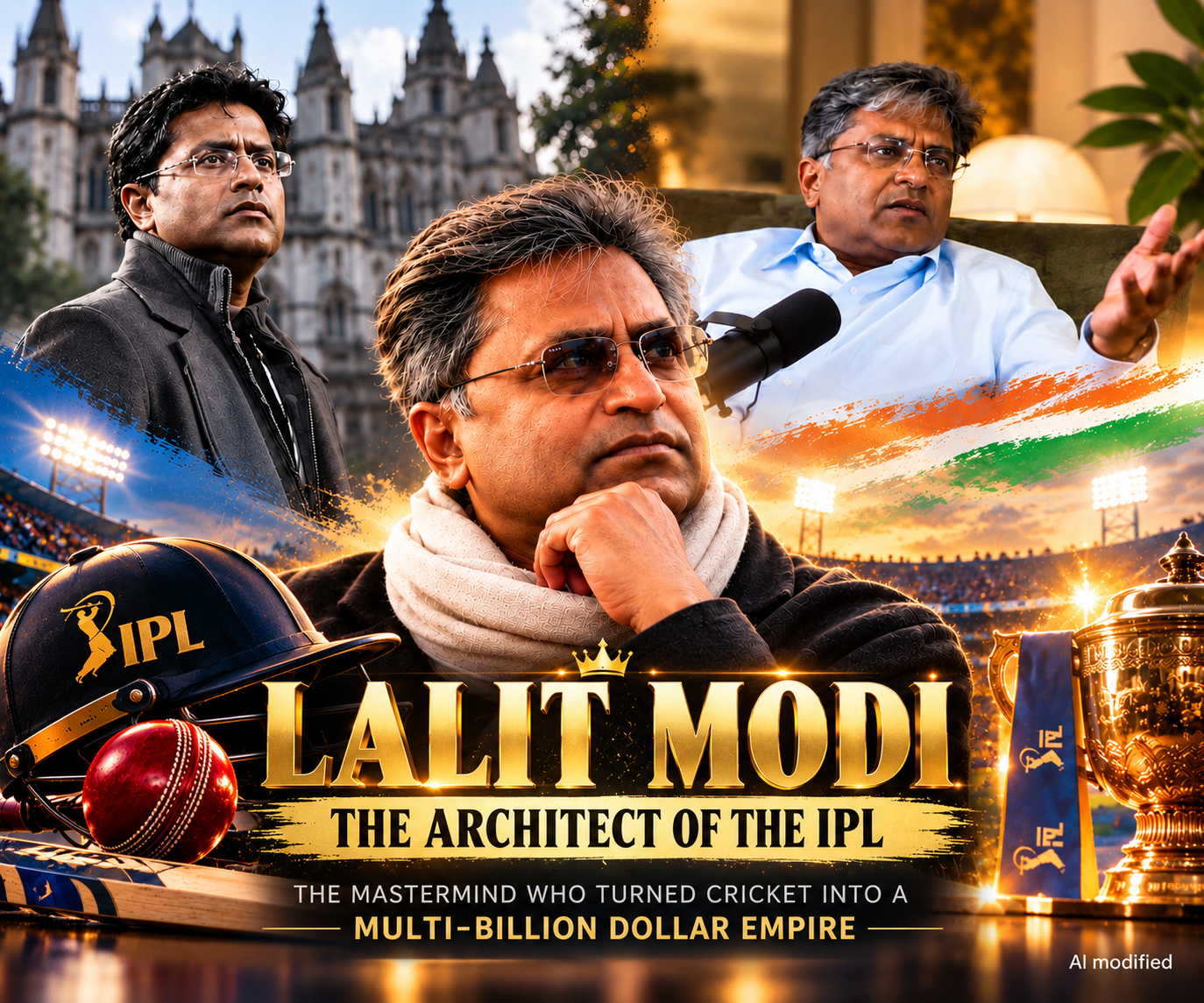
On 18 April 2008, floodlights came on over a cricket stadium in Bengaluru for a match India had never seen before. The Indian Premier League had arrived. The man who built it was Lalit Modi, the league’s first chairman and commissioner. He did not invent the T20 format. The England board did, in 2003. But he turned it into one of the biggest sporting shows on earth. That is the achievement at the heart of his story.
Lalit Modi and the Making of the IPL
Lalit Modi was born on 29 November 1963 in Delhi. He came from a well-known business family. His grandfather, Gujarmal Modi, built the Modi Group and the town of Modinagar. His father, Krishan Kumar Modi, grew the business further. Modi studied in the United States in the early 1980s. Back home, he ran several family firms, including Modi Enterprises and Indofil Industries. His path to cricket ran through administration. In 2004, he became vice-president of the Punjab Cricket Association.
A year later, he took charge as president of the Rajasthan Cricket Association. By 2005, he was also a BCCI vice-president. That is where the IPL began. The BCCI approved a new city-based T20 league. When it launched in 2008, Modi became its first chairman and commissioner. He was 44 when the first ball was bowled. He ran the league for three seasons, until 2010.
The Auction That Made Cricket Rich
Modi’s first masterstroke was the franchise auction. Eight city teams went under the hammer. They had a combined base price of US$400 million. The final bids more than doubled it, reaching US$723.59 million. Mukesh Ambani bought the Mumbai Indians. Vijay Mallya took Royal Challengers Bangalore. Shah Rukh Khan and Preity Zinta joined in too.
Then came the player auction in February 2008. MS Dhoni became the highest buy at US$1.5 million. Andrew Symonds was the priciest foreign player at US$1.35 million. Sanath Jayasuriya went for just under a million. The league also sold its broadcast rights to Sony and the World Sports Group. The deal ran for ten years. It was worth more than US$1 billion. Suddenly, Indian cricket was big business.
Turning T20 Cricket Into a Spectacle
Modi’s real innovation was packaging. He treated cricket like entertainment, not just sport. Teams belonged to cities, not states. Film stars and business houses owned them. Night matches, music and packed stadiums became the norm. The cricket itself delivered. The first season ran from 18 April to 1 June 2008. Each of the eight teams played the others home and away. The opening match pitted Kolkata against Bengaluru. In the final, Shane Warne’s Rajasthan Royals beat the Chennai Super Kings in a last-ball thriller.
The league also backed young talent. A 2008 under-19 draft brought Virat Kohli to the Royal Challengers for about US$30,000. That gamble aged very well.
Lalit Modi – Lasting Impact and Recognition
The numbers arrived fast. Between 2005-06 and 2007-08, BCCI income more than doubled. It crossed Rs 1,000 crore. Media rights drove much of that jump. The IPL itself grew into one of the world's biggest sports leagues, worth over US$4 billion. Top players from every cricketing nation now plan their year around it. The idea travelled. Australia launched the Big Bash League in 2011. Bangladesh, the Caribbean and Pakistan followed with their own T20 leagues. England's Hundred came a decade later. All borrowed from Modi's city-franchise model.Modi also chaired the Champions League T20 from 2008 to 2010. In 2008, CNBC Awaaz honoured him for transforming cricket in India. That year, BCCI president Sharad Pawar called the league “one of the strongest brands that India has in the world.” Others went further. In 2006, the former England captain Mike Atherton called Modi “arguably the most important cricket administrator in the world today.” The BBC later described him as “cricket’s answer to Don King of boxing or Bernie Ecclestone of Formula One.”
Modi’s story took a harder turn in 2013, when the BCCI banned him for life over what it called misconduct and indiscipline. He has always denied wrongdoing and has never been convicted of any crime. His legal fortunes have since turned. In July 2026, a tribunal set aside the penalty against him in a foreign-exchange case tied to the 2009 IPL, and he now plans to visit India again, for the first time in about 16 years.
The Wise Take
Lalit Modi’s idea changed cricket for good. He saw that the game could be a product, and that fans would turn up for the drama. Others built on what he started, but the blueprint was his to make. That is the lesson here. One bold format can reshape an entire sport. The IPL now runs every year, watched by millions around the world. Its sheer scale is the clearest proof of the vision that launched it.
Also read our other article on Manya Harsha: The Bengaluru Teenager Who Turned Her Grandmother’s Old Sarees Into a City-Wide Green Movement
Follow The Wise Indian for more stories about the people and ideas quietly reshaping India.



