

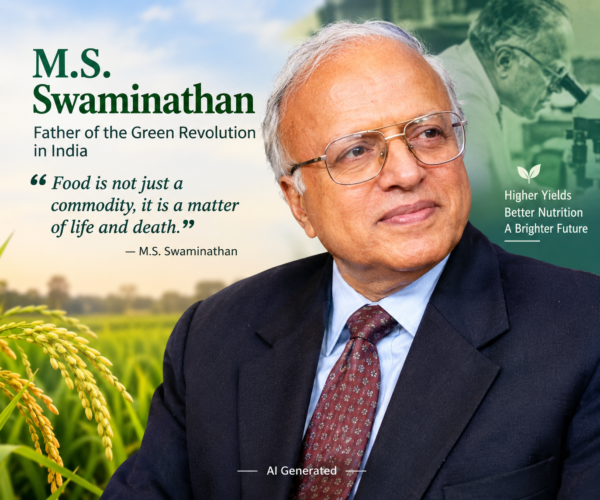
The Scientist Who Chose Bread Over Medicine
M. S. Swaminathan grew up in a family of doctors. Naturally, he was expected to become one too. In 1943, when he was just eighteen years old, he enrolled in a medical college in Madras. But that same year, something happened that would change the course of his life and the future of India.
Swaminathan had grown up in Kumbakonam, Tamil Nadu, in a family that valued education and public service. His father, M. K. Sambasivan, was a doctor who had also participated in the freedom movement. That early environment exposed Swaminathan to both science and the idea of serving society.
The Famine That Rewrote His Future
The Bengal famine of 1943 killed an estimated three million people. The images of starving families and abandoned villages reached every corner of the country. For young Swaminathan, the suffering was impossible to ignore. He later recalled a line from Gandhi that haunted him: for the poor, God is bread.
The famine showed him that hunger could destroy lives even when food existed somewhere in the country. Poverty, distribution, agricultural production and access to food could all determine whether a family survived.
He could not look away. He decided that medicine could heal individuals, but agriculture could feed a nation. So, he left medical college and joined the Agriculture College at Coimbatore. It was a decision that his family struggled to understand. But it was the beginning of a journey that would save millions of lives.
His decision also came at a critical moment for India. The country remained heavily dependent on agriculture, while farmers faced low productivity, unpredictable rainfall and limited access to modern farming technology. Swaminathan believed science could change that equation.
The Jobs He Said No To
In 1949, Swaminathan cleared the Civil Service Examinations. The government offered him a position with the Indian Police Service. It was one of the most secure and respected jobs in the country. He turned it down.
He chose to continue his research in agriculture. Then he went to Europe to study at the Wageningen Agricultural University and the University of Cambridge. In the 1950s, a prestigious American university offered him a faculty position. He rejected that too. He wanted to work in India, for India.
These decisions reveal something important about his career. Swaminathan did not see scientific success only as a personal achievement. He wanted his work to address India’s most urgent problems.
He returned to a country where food security remained a national concern. India needed scientists who could develop crops suited to its own conditions rather than simply import solutions from elsewhere.
The Partnership That Changed Indian Agriculture
Swaminathan returned home and joined the Indian Agricultural Research Institute in New Delhi. There, he met Dr. Norman Borlaug, the American agronomist who had developed high-yielding dwarf wheat varieties. The two men formed a partnership that would transform India’s farms.
Borlaug’s work had already demonstrated the potential of high-yielding wheat. However, Swaminathan understood that India needed to adapt those advances to local conditions. The challenge involved more than simply introducing a new seed.
Swaminathan adapted Borlaug’s wheat varieties to Indian soil and climate conditions. He worked with a team of scientists and government officials. They persuaded farmers to adopt the new seeds, fertilisers, and irrigation methods. The results were dramatic. India’s wheat production tripled in just fifteen years. A country that had once depended on foreign food aid became self-sufficient. The “begging bowl” became a “bread basket.”
From Begging Bowl to Bread Basket
The transformation changed the relationship between Indian agriculture and scientific research. Farmers could now combine improved seeds with irrigation, fertilisers and better farming practices to produce significantly larger harvests.
Swaminathan is credited with saving more people from starvation than almost anyone in modern history.
Yet the Green Revolution was never simply the achievement of one scientist. Farmers played a central role in adopting new technologies, while policymakers built systems that supported production, procurement and food distribution.
The Evergreen Revolution
Swaminathan did not stop at the Green Revolution. He understood its limitations. Intensive farming had depleted soils and water tables. He began advocating for what he called an “Evergreen Revolution.” This approach integrated technology with ecology and promoted sustainable practices.
The idea reflected a concern that would become increasingly important in the decades that followed. Producing more food could not remain the only measure of agricultural progress. Farmers also needed healthy soil, reliable water supplies and resilient ecosystems.
He founded the M. S. Swaminathan Research Foundation in 1988. The foundation worked on rural development, climate-resilient farming, and the empowerment of women farmers. He believed that gender equity was central to agricultural progress.
His later work therefore expanded the definition of food security. It included not only the availability of food, but also the livelihoods of farmers, the health of rural communities and the long-term sustainability of agriculture. He received the Padma Vibhushan, the World Food Prize, and numerous other honours. He was also nominated for the Nobel Peace Prize.
But recognition did not end his concerns about India’s agricultural future. He continued to argue that farmers needed better access to technology, markets, knowledge and opportunities.
The Wise Take
M. S. Swaminathan died on 28 September 2023 at the age of 98. Prime Minister Narendra Modi called him a true “Kisan Vaigyanik,” a scientist who worked for the farmers.
His life was a series of choices that most people in his position would not have made. He gave up a medical career, a secure government job, and the comfort of living abroad. Each time, he chose a harder path because it promised a greater purpose.
Swaminathan once said that the 1943 Bengal famine was the defining moment of his life. He spent the next eight decades making sure that such a famine never happened again. He succeeded. His legacy lives in every field that yields a healthy harvest.
But his legacy also carries a warning for the future. The challenge is no longer only to produce enough food. India must also ensure that agriculture can withstand climate change, protect natural resources and provide farmers with sustainable livelihoods.
That may be the most important lesson from Swaminathan’s life. A scientist can change a country’s future not only through discoveries, but by choosing problems that matter to millions of people.
For more such articles, stay tuned to The Wise Indian.



