

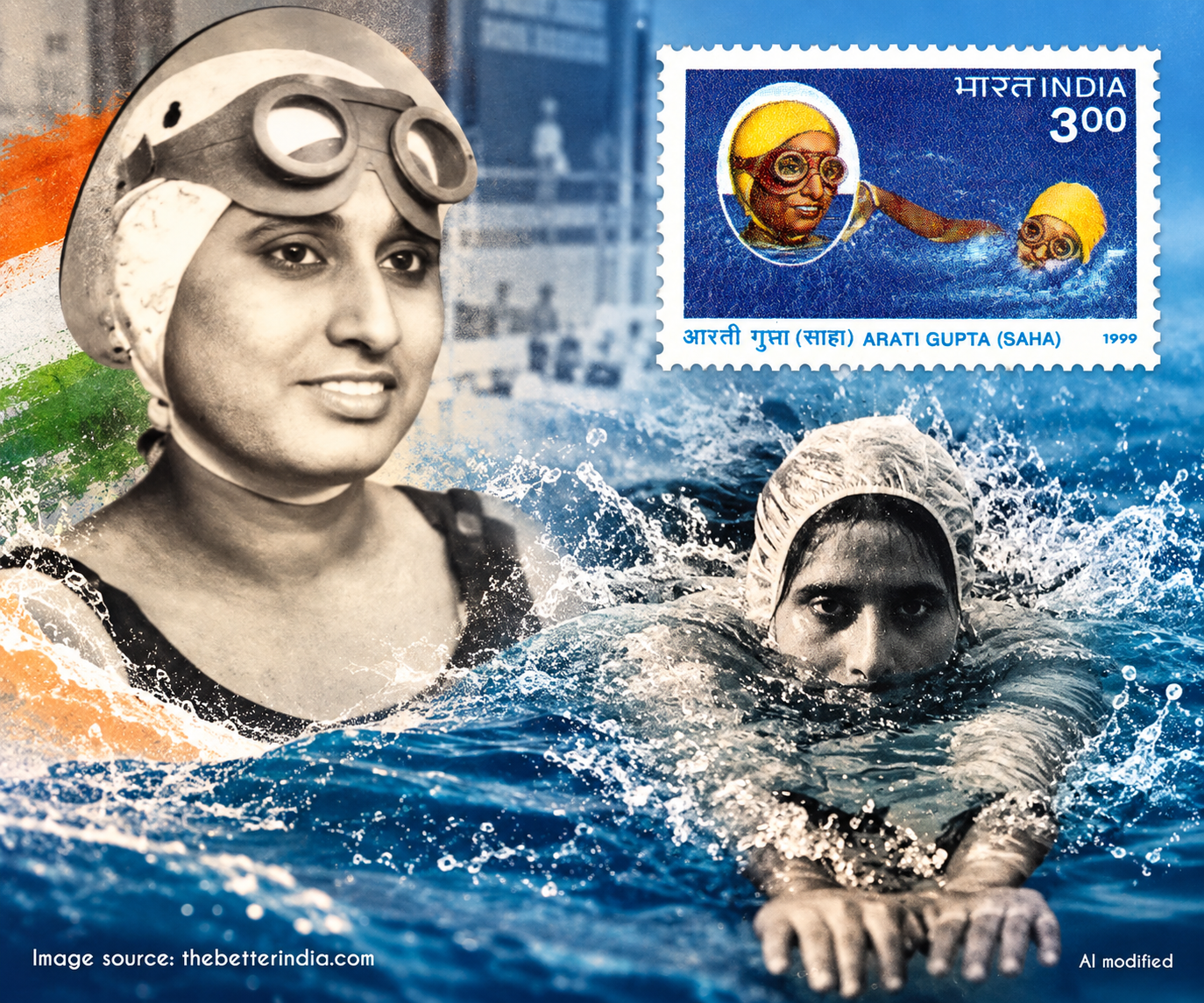
On 29 September 1959, a 19-year-old woman from Kolkata stepped into the sea off the coast of France and did not come out again for more than sixteen hours. When she finally reached England, Arati Saha had become the first Asian woman to swim the English Channel.
What makes the story remarkable is not just the distance. It is how she got there. She had lost her mother at two and a half, learned to swim in a river ghat in North Kolkata, and failed at this very crossing a month earlier, stopping just five miles from the English coast.
Arati Saha: The Girl Who Learned to Swim at Champatala Ghat
Arati Saha was born on 24 September 1940 in Kolkata. She was the second of three children and the elder of two daughters born to Panchugopal Saha, who worked for the Indian Armed Forces. Her childhood was not an easy one as her mother died when Arati was two and a half. Her elder brother and younger sister went to live with a maternal uncle, while Arati was raised by her grandmother in North Kolkata.
At the age of four, she went along with her uncle to the Champatala Ghat on the Hooghly, and there she learned to swim. Her father saw something in her and enrolled her at the Hatkhola Swimming Club. It did not take her long to stand out. She won her first gold medal at five, under the guidance of her mentor Sachin Nag. By 1951, while still a schoolgirl, she had broken Dolly Nazir’s all-India record in the breaststroke. She trained at Deshbandhu Park in Kolkata, and by her early teens she was already one of the country’s best swimmers.
From the Olympics at Eleven to the English Channel
In 1952, Arati was selected to represent India at the Helsinki Olympics in the 200 metre breaststroke, alongside Dolly Nazir. She was not yet twelve years old. She clocked 3 minutes and 40.8 seconds in her heat, and though she did not advance, she had already done something no Indian woman had done at that level. The idea of the Channel came later, and it came from another swimmer.
In 1958, Brojen Das became the first person from the Indian subcontinent to swim across the English Channel, winning the Butlin International Cross Channel Swimming Race. Reading about his feat, Arati decided she would attempt it too. There was one large problem: money. An English Channel attempt needed a pilot boat, a crew, and weeks of living and training abroad, and none of it was cheap. Sambhunath Mukherjee and Ajay Ghoshal, who supported her, approached Dr. Bidhan Chandra Roy, then Chief Minister of West Bengal, who arranged a grant of ₹11,000. Prime Minister Jawaharlal Nehru also offered his support.
The First Attempt That Fell Five Miles Short
Arati entered the 1959 Butlin International Cross Channel Swimming Race. The swim was scheduled for 27 August 1959, starting at 1 am local time from Cape Gris Nez in France and aiming for Sandgate on the English coast. But her pilot boat did not arrive on time. She began about forty minutes late and lost the tide and conditions the early start had been planned around.
Even so, she swam strongly. By 11 am she had covered more than forty miles and was within five miles of England. Then the water turned against her. An opposing current set in, and by 4 pm she had managed only about two more miles before she had to stop. Five miles. That was the gap between her and the coast. Most people would have gone home. Arati stayed, trained, and waited for another chance.
The Day She Raised the Tricolour in England
That chance came a month later. On 29 September 1959, Arati set off again from Cape Gris Nez. This time the pilot boat was there, and so was the swim. She swam for 16 hours and 20 minutes, covering roughly 42 miles, or about 67 kilometres, along the route to reach Sandgate in England. Her crossing was piloted by Leonard Hutchinson aboard the boat Envictor. When she reached the English coast, she raised the Indian national flag. She was 19 years old, and she had just become the first Asian woman and the first Indian woman to swim the English Channel.
What Arati Saha’s Swim Meant for India
Recognition followed quickly. In 1960, Arati received the Padma Shri, becoming the first Indian sportswoman to be given the honour. Her life after the swim was quiet. She later married Dr. Arun Gupta, who had managed her career and travelled with her to England, and the couple had a daughter. Then, she took up a job with the Bengal Nagpur Railway and lived largely out of the spotlight. She died in Calcutta on 23 August 1994, at the age of 53. The country did not forget her.
In 1999, the Department of Posts issued a ₹3 stamp in her name. A lane in Kolkata was renamed after her, with a bust installed in her memory. And on 24 September 2020, what would have been her 80th birthday, Google marked the occasion with a doodle that traced her route from France to England. Her swim mattered because of its timing. In 1959, very few Indian women competed at the international level in any sport, and even fewer had a state government and a prime minister behind them. Arati Saha did not just swim a distance. She showed what an Indian woman could be trusted to do.
The Wise Take
The most telling part of Arati Saha’s story is not the 16 hours and 20 minutes. It is the month before it, when she stopped five miles from England and got back in the water anyway. That is the lesson here. A first attempt is not a verdict, and a failure is often just a delay. She was 19; she had already lost once, and she still went back to finish what she had started.
Also read our other article on The Inspiring Journey of Mihir Sen, the First Asian to Conquer the English Channel
Follow The Wise Indian for more stories about the athletes, changemakers and everyday heroes quietly shaping a better India.



