

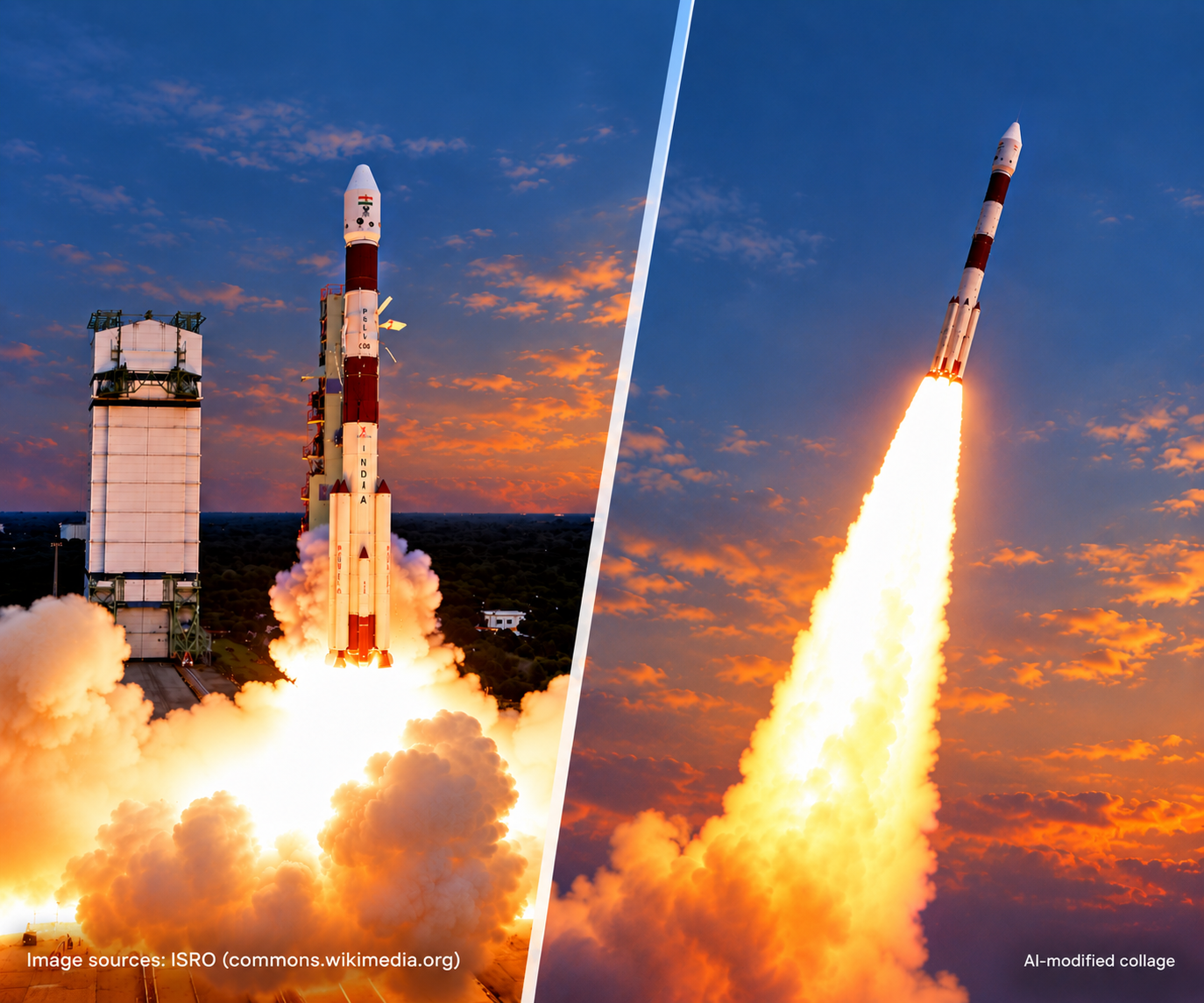
On 28 September 2015, India crossed a rare scientific milestone. At 10:00 am IST that morning, a PSLV-XL rocket lifted off from Sriharikota carrying the AstroSat space observatory into the sky. It carried with it years of quiet effort from Indian scientists and engineers.
The AstroSat Space Observatory: A Telescope Built to See Everything at Once
Most satellites are built to do one thing well. AstroSat was different from the start. It was designed to study stars, galaxies, and black holes across multiple types of light at the same time. This included ultraviolet light, visible light, and X-rays. Very few space telescopes anywhere in the world could manage all three together. That made the AstroSat space observatory genuinely unusual.
There is a reason this has to happen above the atmosphere. Most X-rays and ultraviolet light from distant objects are absorbed by Earth’s air before they ever reach the ground. To study the universe in those wavelengths, a telescope has to be placed in orbit. That is exactly what the AstroSat space observatory was built to do. It carried five separate instruments, working in coordination. Together, they could observe the same cosmic event in several wavelengths at once, something scientists rarely get to do in a single mission.
Each instrument had its own job. The ultraviolet telescope imaged the sky in far-ultraviolet, near-ultraviolet and visible light at the same time. The large area counters measured X-rays with fine timing. The cadmium-zinc-telluride imager worked in hard X-rays and could also measure their polarisation. A scanning monitor kept watch for new X-ray sources, while a soft X-ray telescope focused low-energy X-rays. Together they gave Indian astronomers five ways of looking at the same object.
The Teams Who Built It, Piece by Piece
AstroSat wasn’t built by one lab alone. It came together through years of collaboration between ISRO’s satellite centre in Bengaluru and several respected Indian research institutes. The Tata Institute of Fundamental Research built three of its five instruments. The ultraviolet telescope was led by the Indian Institute of Astrophysics in Bengaluru, with the Inter-University Centre for Astronomy and Astrophysics in Pune and the Canadian Space Agency among its partners. ISRO built the instrument that scans the sky for new X-ray sources. Scientists from Leicester University in the UK also contributed, supplying the camera for the X-ray telescope. This wide circle of collaboration reflected something important. Building a space observatory needed patience, shared knowledge, and people willing to work quietly for years without public recognition.
Lift-off and the moment it opened its eyes
The satellite launched aboard ISRO’s PSLV-C30 rocket, in its more powerful XL configuration. Around twenty minutes after lift-off, AstroSat settled into its intended orbit, roughly 650 kilometres above Earth. Its earliest result came quickly. The hard X-ray instrument was made operational on 5 October 2015, and the following day the observatory was pointed at the Crab Nebula. It detected the nebula on 9 October.
Then, on 26 October 2015, the soft X-ray telescope opened its camera door to the sky for the first time. Its first-light image captured a distant blazar, PKS 2155-304, an active galaxy whose jet of particles points almost directly at Earth. Those early observations confirmed months of careful engineering had paid off.
What it meant for India’s place in astronomy
Before AstroSat, only a small number of countries had ever launched a dedicated space telescope of this kind. With this launch, India joined that short list. It was a quiet but significant marker of how far the country’s space programme had come.
AstroSat was designed to operate for five years. Remarkably, it has continued working well beyond that, still gathering useful data years later. Along the way, it has helped researchers make discoveries that would have been difficult from ground-based telescopes alone, including detecting ultraviolet light from galaxies billions of light years away.
What makes this story compelling isn’t just the launch itself. It’s the years of unglamorous, careful work by scientists across different institutes that came before it. Nobody involved was chasing headlines. They were solving one small engineering problem after another, for years, until a rocket finally carried their work into orbit.
The Wise Take
AstroSat’s story is a reminder that big scientific milestones rarely come from a single spark of genius. They come from patient teams across different institutes, each solving a small piece of a much larger puzzle. A decade later, it’s still up there, quietly doing exactly what it was built to do.
Also read our other article on Indian Dressage Team: How Four Riders Ended India’s 41-Year Wait for Equestrian Gold at the Asian GamesFollow The Wise Indian for more stories about the scientists, changemakers and everyday heroes quietly shaping a better India.



