

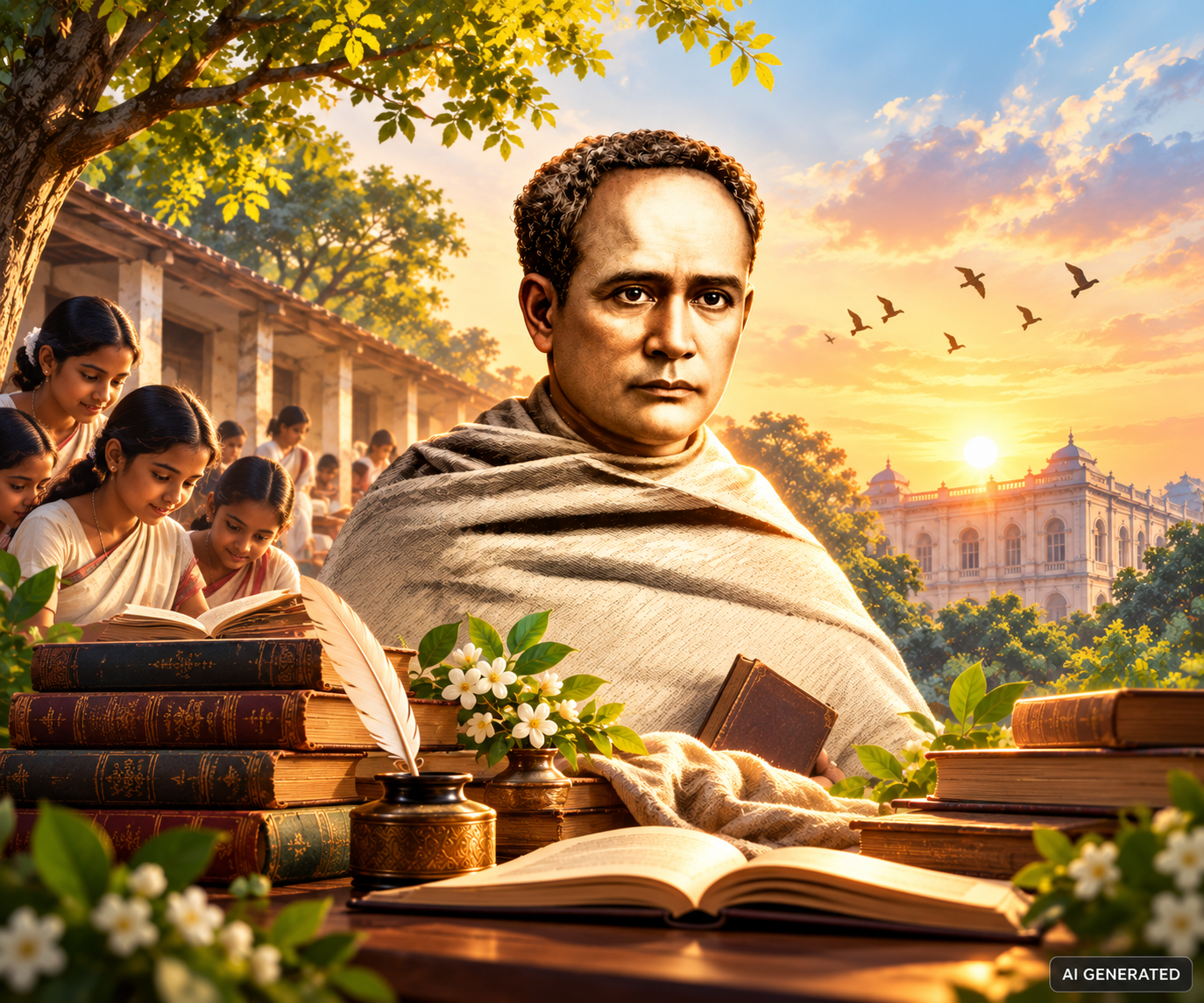
In Calcutta, more than two centuries ago, a poor boy had a problem that sounds almost absurd today: Vidyasagar wanted to study, but his family could not afford a lamp.
So Ishwar Chandra Bandyopadhyay walked outside and studied beneath gas-lit street lamps.
He had arrived in Calcutta from Birsingha as a child, accompanying his father, Thakurdas, who had come to the city in search of opportunity. Money remained painfully scarce. Ishwar Chandra helped with household work, cooked, shopped for the family and studied whenever he could. Yet he kept climbing academically, eventually spending more than a decade at Sanskrit College and mastering Sanskrit grammar, literature, logic, Vedanta, Smriti and astronomy. In 1839, his scholarship earned him the title “Vidyasagar” — the Ocean of Knowledge.
But knowledge, for Vidyasagar, was never meant to remain inside a classroom. That is the part of his story we often miss.
He Did Not Just Argue for Widow Remarriage
By the 1850s, Vidyasagar had become deeply involved in one of nineteenth-century Bengal’s most explosive social questions: whether Hindu widows should be allowed to remarry.
He did not approach the issue simply as a Western-educated reformer attacking Hindu tradition. Instead, he went into the Sanskrit texts themselves.
He published arguments based on Hindu legal and religious authorities, particularly the Parashara Samhita, to show that the absolute prohibition on widow remarriage did not have the scriptural foundation his opponents claimed. His opponents answered with their own interpretations of the same texts. The debate became a battle not merely of morality, but of scholarship.
Then Vidyasagar took the argument somewhere more dangerous. He asked the colonial government to change the law.
On October 4, 1855, Vidyasagar and roughly a thousand supporters submitted a petition to the Legislative Council asking it to remove legal obstacles to Hindu widow remarriage. The response was enormous. An opposing petition, associated with Raja Radhakanta Deb and the Dharma Sabha, eventually carried 36,763 signatures. That figure dwarfed Vidyasagar’s petition. The documentary record suggests he was pushing the argument uphill against a far larger organised opposition.
And yet, the law passed. On July 16, 1856, the Hindu Widows’ Remarriage Act was enacted, removing legal obstacles to remarriage. But Vidyasagar understood something legislation alone could not fix.
A law could make a widow’s remarriage legal. It could not persuade a family to accept her.
So He Put His Own Money Behind His Beliefs
This is where Vidyasagar’s story becomes considerably more interesting. He did not stop after getting the law passed.
The first marriage under the new Act took place in Calcutta on December 7, 1856, between Sris Chandra Vidyaratna and Kalimati Devi, a widow. Vidyasagar helped make the marriage happen and spent heavily to support the movement. The event drew such a large crowd that police were stationed along the route because authorities feared violence.
His opponents did not merely disagree with him. Historical accounts describe public abuse, threats and even an attempt on his life. His father reportedly sent a clubman named Srimanta to act as his bodyguard. And the financial cost kept growing.
Vidyasagar borrowed heavily to support widow remarriages. At one point, records from his own lifetime state that around sixty marriages had cost approximately ₹82,000 — a staggering sum for the period. He eventually cleared the debts. That detail changes the familiar image of Vidyasagar.
He was not simply a man who wrote a petition and waited for the government to act. He financed the consequences of his own ideas.
The Same Man Was Quietly Rebuilding Education
His reformism also extended far beyond widow remarriage.
As secretary of Bethune School, Vidyasagar helped advance female education in Bengal. One revealing detail survives from that period: he selected a Sanskrit verse for the school’s carriage that essentially told families that daughters, like sons, deserved careful upbringing and education. He deliberately used scripture to challenge the claim that educating girls violated Hindu tradition.
Then there was Barnaparichay, his Bengali primer published in 1855. It sounds like a small achievement compared with changing a law. It wasn’t.
Vidyasagar simplified Bengali prose and made learning less dependent on dense, formal language. Barnaparichay used short sentences, familiar words and systematic exercises, helping generations of Bengali children learn to read. It also became influential in standardising Bengali orthography and punctuation.
In other words, Vidyasagar attacked inequality from two directions. He tried to change the law that constrained women. And he tried to change the classroom that shaped everyone.
Then He Walked Away From Calcutta
Perhaps the least remembered chapter of his life came much later. From 1873, Vidyasagar spent long periods in Karmatar, in present-day Jharkhand. There, far from the intellectual centre of Calcutta, he established a girls’ school and a night school for adults. He also ran a free homoeopathic clinic for local people.
The image is striking. The boy who once studied under a street lamp had spent his life building institutions for people who had never been given much access to education.
The Wise Take
Vidyasagar is often remembered as a great scholar who helped legalise widow remarriage. That is true, but it misses the harder part of his story.
Vidyasagar fought when the numbers were against him. He argued with people who knew the same scriptures he did and put his own money behind marriages that society wanted to prevent.
And perhaps that is why the street lamp matters. The story is not really about a poor boy studying beneath someone else’s light. It is about what he eventually did with the light he acquired. He used it to make other people’s paths a little easier to see.
For more such articles, keep reading The Wise Indian.



