

For a year, Salman Khan drove a battered WagonR along one of the country’s busiest stretches of road. The Delhi-Gurgaon route is a blur of honking, exhaust fumes, and the relentless rush of people chasing their own deadlines. He drove from 5 am to 9 am, and then again from 5 pm to 10 pm, shutting out the noise, trying to find some semblance of sanity in a life that had been upended.
He was 19 years old.
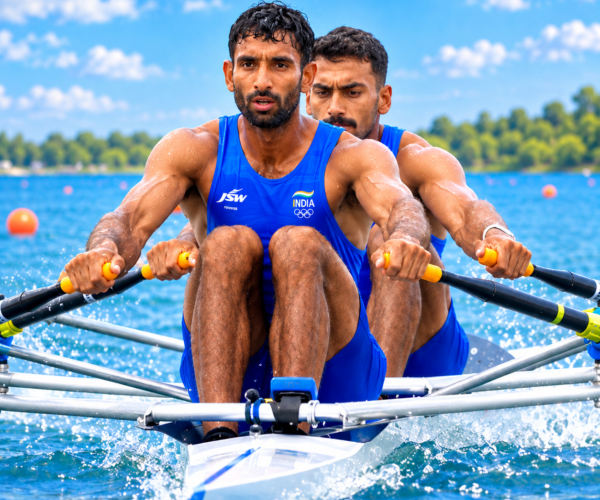
On Thursday, on the calm waters of the Nagara river in Aichi-Nagoya, Japan, that same young man sat in a sculling shell with a sailor from the Indian Navy, Satnam Singh, and rowed his way into the history books. The bronze medal they won in the men’s double sculls was India’s first-ever at the Asian Games in this event. For Salman, it was the culmination of a journey that began with a crushing loss and a steering wheel.
The Weight of Responsibility
Salman Khan’s story starts in Amethi, Uttar Pradesh, but it was in Tauru, Haryana, where his childhood unfolded. His father worked on truck bodywork, and the family lived a modest life. In 2016, his father passed away. Salman Khan was around 17 or 18. He was the eldest of six siblings. The family had to leave their home and return to their village.
“My brothers had to study, sisters had to be married. I was the eldest, so it was my responsibility. I had to earn,” Salman told The Indian Express.
So he moved to Delhi. He got behind the wheel of a WagonR and became an Uber driver. The cab was not a choice; it was a necessity. It put food on the table and kept the household running. But even as he drove, he kept filling out recruitment forms for the Indian Army. It had been his father’s dream for him to join the defence forces.
A Second Attempt
His first attempt at the Army failed. The rejection was bitter enough that he told his mother he would give up and stick to driving for Ola. His relatives and neighbours, however, saw something in his tall, six-foot-four frame. They encouraged him to try again. This time, he passed.
Joining the Army, as it turned out, would change the entire arc of his life. It was also where he discovered rowing. The coaches at the Bombay Engineering Group introduced him to the sport in 2018. Salman was, by his own admission, a reluctant rower. “I didn’t even know how to swim. I didn’t want to do rowing,” he later said. Early in his training, the boat overturned. He was terrified.
He came close to quitting twice. Both times, his coaches and commanding officers convinced him to stay. He went on to win gold at the 2022 National Games in Gujarat, and another gold at the Senior Nationals in 2023.
The Night Before the Race
The path to the podium in Nagoya was anything but smooth. Days before the event, the Indian rowing team was thrown into disarray. The crew Salman and Satnam had trained with for six months was broken up. The two men were moved into the double sculls event. They had barely five days to learn to row together.
The night before their race, they did not eat. They could not sleep. The two men were, in Salman’s words, in depression. They had trained together for half a year, had built a brotherhood, and suddenly, they were rowing in a boat with a near-stranger.
But when they pushed off from the dock on Thursday morning, they had made a decision. “We row for the country,” Satnam said.
They finished in 6 minutes and 13.25 seconds. The bronze medal was theirs.
What the Medal Carries
Back in Amethi, the family woke up at 4 am to pray. By 5 am, the news had arrived. Salman’s mother, Jabrun Nisha, told ANI that the joy was beyond words. “We knew he went to play, so we have been praying for days,” she said.
The bronze is more than a medal. It is a testament to what happens when a young person refuses to let circumstances define the limits of their life. Salman Khan did not have the luxury of a straight path. He had to drive a cab to keep his siblings fed. When he failed an exam and almost gave up. He learned to row in his twenties, scared of the water.
And yet, on a quiet river in Japan, he proved that the distance between a driver’s seat and an Olympic podium does not depend on kilometers. It depends on the quiet, unyielding decision to keep going.
The Wise Take
The world will remember that a Khan and a Singh won India’s first medal in double sculls at the Asian Games. But for Salman Khan, it is something simpler. It is a promise he kept to a father who wanted him to wear the uniform. He fulfilled that responsibility.
For more such articles on resilience, keep reading The Wise Indian.



