

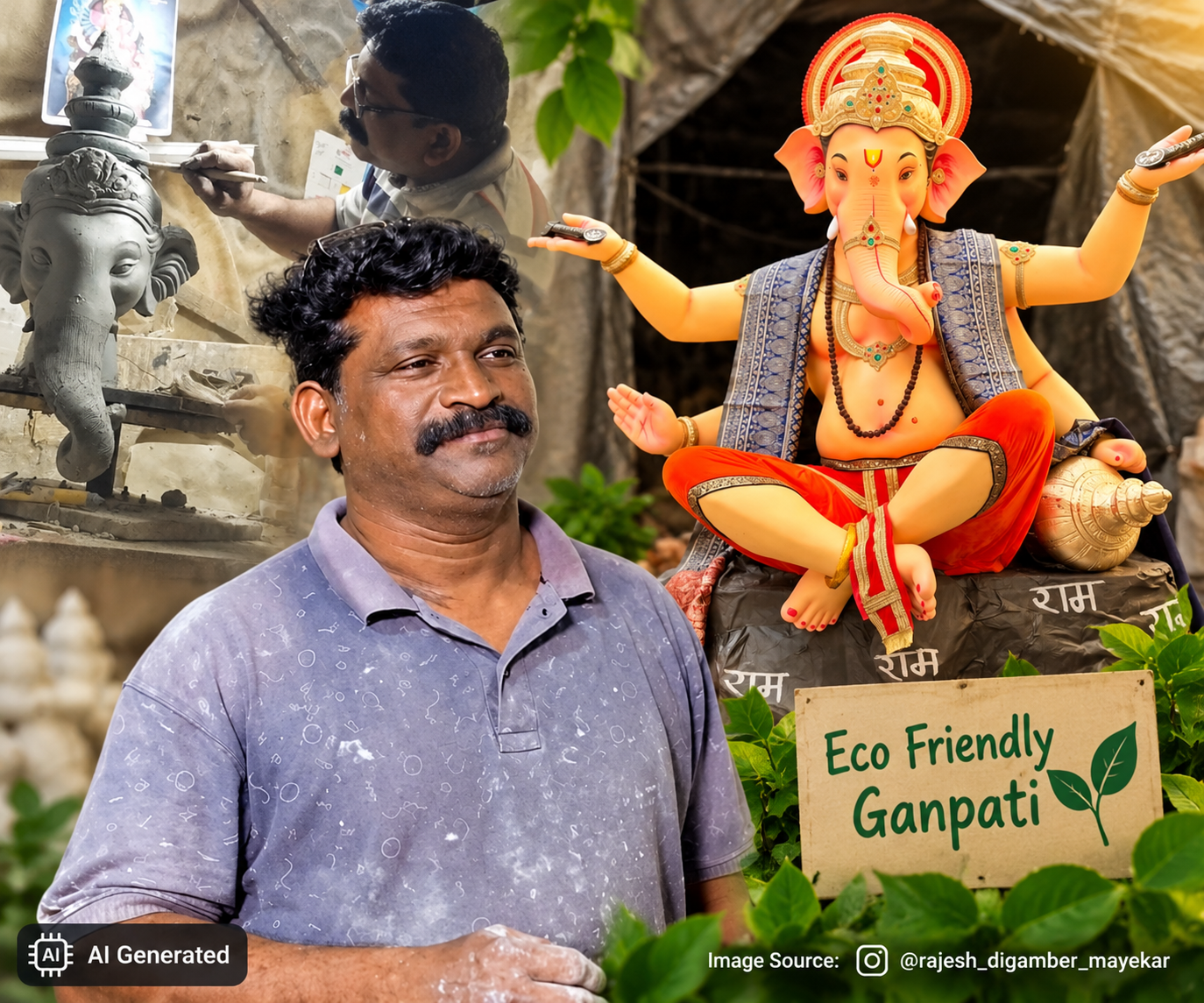
For most Ganesh Chaturthi celebrations, the festival ends the same way every year. Devotees immerse a plaster-of-Paris idol in a lake, pond, or the sea. The water stays murky for weeks. One mandal in Mumbai’s Vile Parle has spent 19 years refusing to follow that pattern. Instead, they build a fresh eco-friendly Ganpati idol from scratch every year.
Why One Family Started Making an Eco-Friendly Ganpati Idol
Sunil Mayekar grew up watching the lakes near his home change colour every September. Chalky sludge floated on the surface. Chipped paint settled at the bottom. Some idols wouldn’t dissolve for months. By 2008, his family had seen enough of it. The Mayekars run the Bal Gopal Mitra Mandal, based in Siddhivinayak Society, Vile Parle East. The mandal itself has existed since 1989, holding its own Ganeshotsav celebrations for decades. But 2008 marked a turning point.
Sculptor Digambar Mayekar and his sons, Sunil and Rajesh, are trained idol-makers. They decided to stop buying idols. Instead, they chose to build their own eco-friendly Ganpati idol using tissue paper stretched over a bamboo frame. The technique wasn’t entirely new. It closely resembled the pulped-newspaper idols that many households shape at home, just smaller.
The Mayekars simply took the same principle and scaled it up dramatically. Later, they started mixing in flowers gathered after each festival. The flowers gave each idol texture and natural colour. The base material stayed all natural.
Building a 22-Foot Eco-Friendly Ganpati Idol
Making an eco-friendly Ganpati idol this way takes months of patient, hands-on work, not days. Workers lash bamboo sticks together with natural gum to form a tall skeleton. They layer soaked tissue paper over the frame and leave it to dry in the sun. Work starts after the monsoon. Rain can ruin the paper before it dries.
By 2015, the family had perfected this method at scale. They built a 22-foot idol using 30,000 sheets of tissue paper. It weighed just 150 kg. Reports said it dissolved much faster than a plaster-of-Paris idol of the same size. Only the bamboo skeleton was left to remove afterward.
See the mandal’s real idols on Instagram
Scaling Up With Banana Fibre and Recycled Flowers
In another year, the Mayekars pushed the idea even further. They produced 11 similar idols from a combined 3.55 lakh tissue papers. That was a huge jump for a single family workshop. Mandals in Goregaon, Andheri, Jogeshwari, Santacruz, Thane, and Kalyan bought these idols. The price ranged from ₹30,000 to ₹70,000, depending on the size. Marine biologists said paper-pulp idols were safer for water bodies.
Their cellulose content breaks down naturally in water. Metallic paints still used on many conventional idols remained a separate and ongoing concern. By 2022, the family was experimenting with banana fibre. They had gathered it from wedding halls across the city since January. They mixed the fibre with tissue paper to prevent cracking during the drying process. That year’s finished idol stood 21 feet tall and sat mounted on a sculpted Garuda bird.
This Year’s Idol Reused Last Year’s Immersion Waste
In 2026, the mandal took the idea further than ever before. Their 25-foot idol, named Mumbaicha Peshwa, used tissue paper and paper pulp. The pulp came directly from the previous year’s immersion. The mandal now immerses its eco-friendly Ganpati idol in an artificial tank, not a natural water body.
It uses only as much water as the process really needs. Once immersion finishes, workers collect the leftover pulp. They store it for next year’s idol. Over the past five years, the family has tested many materials. The list includes banana fibre, alum, cocopeat, vegetables, tissue paper, and flowers. Each year, they refine the mix a little further. What worked last time guides the next mix.
The Wise Take
Most eco-friendly idol stories end with a single festival. This one doesn’t. What sets the Bal Gopal Mitra Mandal apart isn’t simply that they avoid plaster of Paris. Many mandals do that now. It’s that they treat every immersion as a starting point. This year’s waste becomes next year’s idol. Most green efforts around Ganeshotsav focus only on what an idol is made of before immersion.
The Mayekars’ real innovation happens after, recovering pulp, storing it carefully, and reusing it months later. Few mandals plan that far ahead. Most see Ganeshotsav as a single annual event. Their 19-year experiment raises a simple but lasting question. Can a tradition stay meaningful while also owning its waste? For one Vile Parle family, the answer is simple: keep asking and keep building.
Read our story on Bittu Tabahi: The 21-Year-Old Cleaning the Ajnar River
Follow The Wise Indian for more articles like this.



