

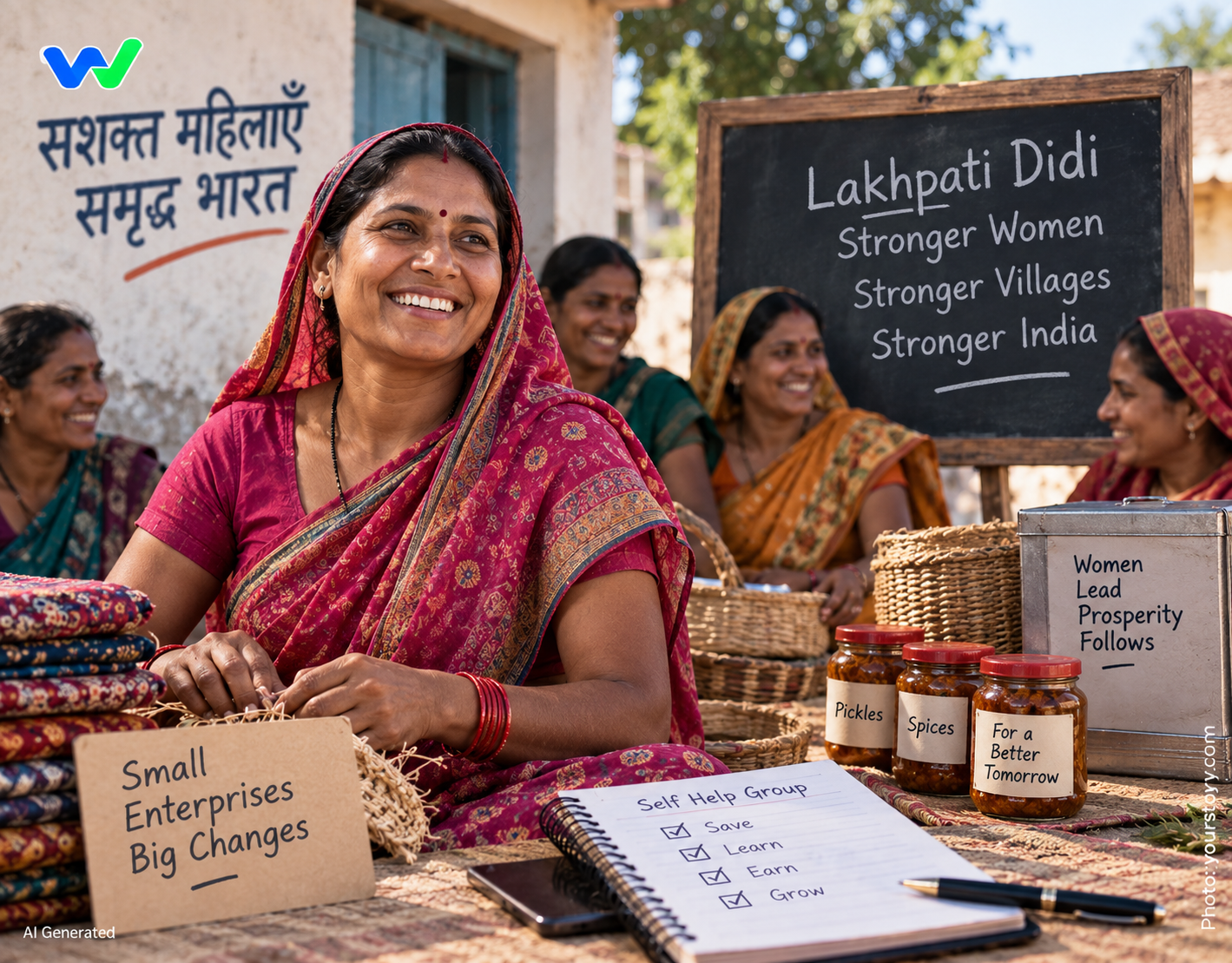
The target was genuinely met, which is rare enough to say plainly. The threshold behind it is what deserves the scrutiny.
From the ramparts of the Red Fort on 15 August 2026, the 80th Independence Day, the Prime Minister said this: “We have surpassed the target we had set of making three crore sisters ‘Lakhpati Didis’. Now, we are moving forward with the target of creating six crore Lakhpati Didis.” Indian government targets get missed far more often than they get met, and a doubled target usually follows a shortfall rather than a success. This one did not. Three crore rural households crossed the line, ahead of schedule. The line is Rs 1 lakh of annual household income, which is Rs 8,333 a month.
What a Lakhpati Didi Actually Is
Lakhpati Didi runs under the Deendayal Antyodaya Yojana National Rural Livelihoods Mission, which sits with the Ministry of Rural Development.
It works through self-help groups. Rural women organise into groups, borrow through them, and start something: livestock, tailoring, food processing, a shop, a service.
The goal is a sustainable annual household income of Rs 1 lakh or more. A woman whose household reaches and holds that is counted.
Lakhpati means someone with a lakh. Here it means a lakh of annual household income. Not savings. Not her own earnings. That distinction does more work than any other detail in this programme, and it almost never appears in the coverage.
Take the Achievement Seriously First
Three crore is thirty million households. Programmes operating at that scale and hitting their number are not common anywhere in the world, let alone in rural India.
The original deadline was March 2027. The government got there early and set six crore, reportedly by March 2029.
The machinery underneath deserves most of the credit. India’s self-help group network took decades to build and is one of the genuine institutional successes of Indian rural development. Lakhpati Didi rides on it rather than replacing it.
Now Look at Rs 8,333
Rs 1 lakh a year is Rs 8,333 a month, and that is the household, not the woman.
A family of four at that threshold has around Rs 2,083 per person per month. About Rs 69 a day each.
Set that beside the rural minimum wage in most states and it is modest. Set it beside a single salaried job in a small town and it is lower.
None of which makes the threshold wrong. A programme aimed at the poorest rural households has to set a bar those households can actually clear, and a bar nobody reaches measures nothing at all.
But the word lakhpati is doing work the number cannot support. It sounds like prosperity. It describes a household that has climbed just clear of subsistence.
Three Questions the Count Does Not Answer
How is the income measured, and by whom. Self-reported household income is hard to capture anywhere, and harder when earnings are seasonal and partly paid in kind.
Does it hold. The definition says sustainable annual income. Count a woman in 2024 and she may be below the line by 2026, and that difference is the difference between a programme and a moment. Nobody publishes re-verification.
And what comes after. Rs 1 lakh is a floor, not a destination. There is no second tier, so a household that crossed it three years ago simply disappears from the story.
The Wise Take
The instinct with a government achievement is to cheer it or to hunt for the catch, and neither is right here.
Thirty million rural households crossing Rs 1 lakh is a real outcome at real scale. Nobody should be sniffy about it.
The trouble is that a threshold has become the headline, and a threshold is a starting line. Counting how many households crossed it proves the programme reaches people. It says nothing about whether their lives changed in a way that survives a bad monsoon.
There is a number that would settle it and the ministry already holds the data. Of the women counted as Lakhpati Didis in 2023, how many were still above the threshold in 2026, and how many have since doubled their income.
Publish that and the six crore target becomes meaningful. Leave it unpublished and in 2029 we will be reading another Red Fort sentence about a number that was met, with no way of knowing what it bought. Women in agriculture are already largely invisible in the records that decide who gets credit, and the self-help group network is the main route around that. Whether it lifts households or only lifts them over a line is a question the data can answer, and nobody has asked it.



