

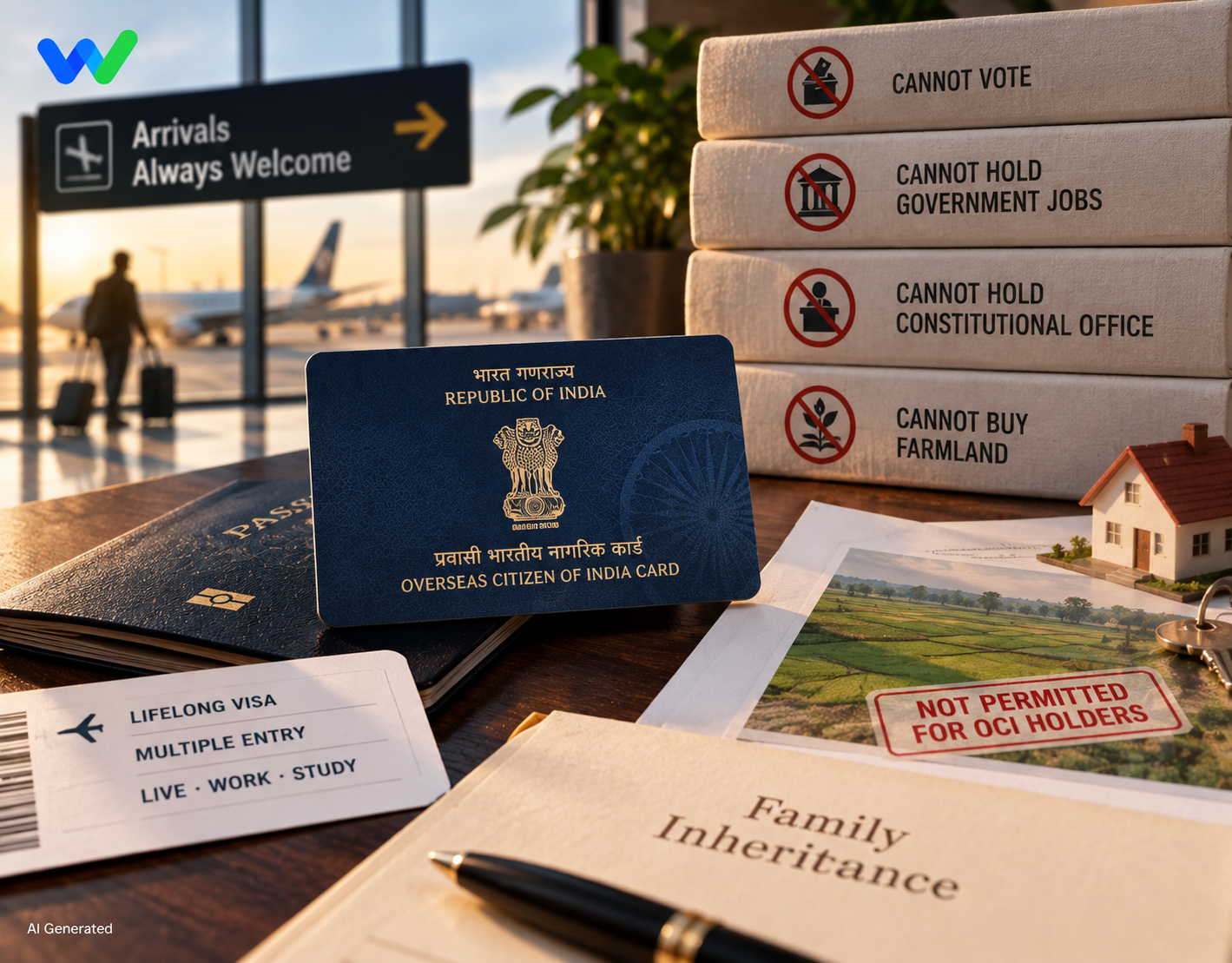
The name promises something the document does not deliver. Four doors stay shut, and one of them is farmland.
The phone call tends to come after a death. Somebody abroad has inherited a share of the family land in India, goes to complete the transfer, and discovers that the card in their wallet does not permit it. An Overseas Citizen of India card sounds like a form of citizenship. It is not one. India does not allow dual citizenship at all.
What the card gives you is a lifelong right to enter, live and work in India. You get most of the economic treatment a non-resident Indian gets. You get none of the political rights a citizen has. Nearly every misunderstanding about it starts with the name.
Who Qualifies
Three conditions.
You hold a valid passport from another country. You are not a citizen of Pakistan or Bangladesh, or of any other country the government names.
And you have the family link. Broadly, a parent or grandparent who held Indian citizenship, or who could have. Spouses of cardholders and of Indian citizens can also qualify, with conditions attached.
The government has revised these rules more than once. Read the current Ministry of Home Affairs conditions. Do not act on what an uncle was told in 2009.
What an Overseas Citizen of India Card Gives You
The visa is the main event, and it is generous.
A lifelong visa, multiple entry. You never reapply. No cap on visits and no cap on how long you stay.
You also skip registering with the local Foreigners Regional Registration Office, no matter how long you are in the country. Anyone who has sat through that will understand what a gift it is.
Beyond travel, an Overseas Citizen of India holder is treated like a non-resident Indian on most money and study matters. Domestic airfares. Entry fees at monuments. NRI status for a range of education and professional purposes.
The Four Doors That Stay Shut
This is the part that gets reported least clearly and matters most.
You cannot vote, in any Indian election, at any level.
You cannot take a government job. Those go to citizens.
You cannot hold constitutional office. No President, Vice-President, Prime Minister, Supreme Court or High Court judge, no seat in Parliament or a state legislature.
And you cannot buy farmland or plantation land. Houses and commercial property are fine. Agricultural land is closed.
That last one is where people get hurt, because it usually surfaces at the worst possible moment.
How to Apply, and the Thing That Trips People
The process runs online through a government portal. You submit passport details, family information, and documents proving the ancestry you are claiming, which usually means a parent’s or grandparent’s Indian passport, birth certificate or domicile certificate. Then you present the originals for checking, at an embassy or consulate abroad, or at a designated office in India.
Fees, timelines and the document list all change, so take them from the portal and not from any secondary source, this article included.
Now the administrative trap. Your card is tied to your foreign passport. Renew the passport and you may need to have the card reissued, or at least register the new passport details, depending on your age and the rules in force. Travellers have been stopped at Indian airports over precisely this, and it is entirely avoidable. Check the rule every time a passport is renewed, and check it twice for children.
The Wise Take
The name was not an accident. Overseas Citizen of India landed well in exactly the years when the diaspora was asking for real dual citizenship and not getting it. The phrase gave people something that sounded like what they wanted.
For most cardholders the trade is fine. The restrictions cover things they will never attempt. Very few people holding a foreign passport were planning to contest a Lok Sabha seat.
Land is the exception and it is serious. A great deal of Indian family wealth sits in farmland. A document that cannot hold farmland is a real limit, and families find that out during probate rather than while planning.
So the practical advice is narrow. Treat the card as what it is, a permanent visa with economic parity, and if your family owns agricultural land in India, find out now how that is going to work rather than in a registrar’s office two years from now. Rules like this change quietly and usually get reported only after somebody is caught out. The Ministry of Home Affairs page is the only version that counts, and it is free.



