

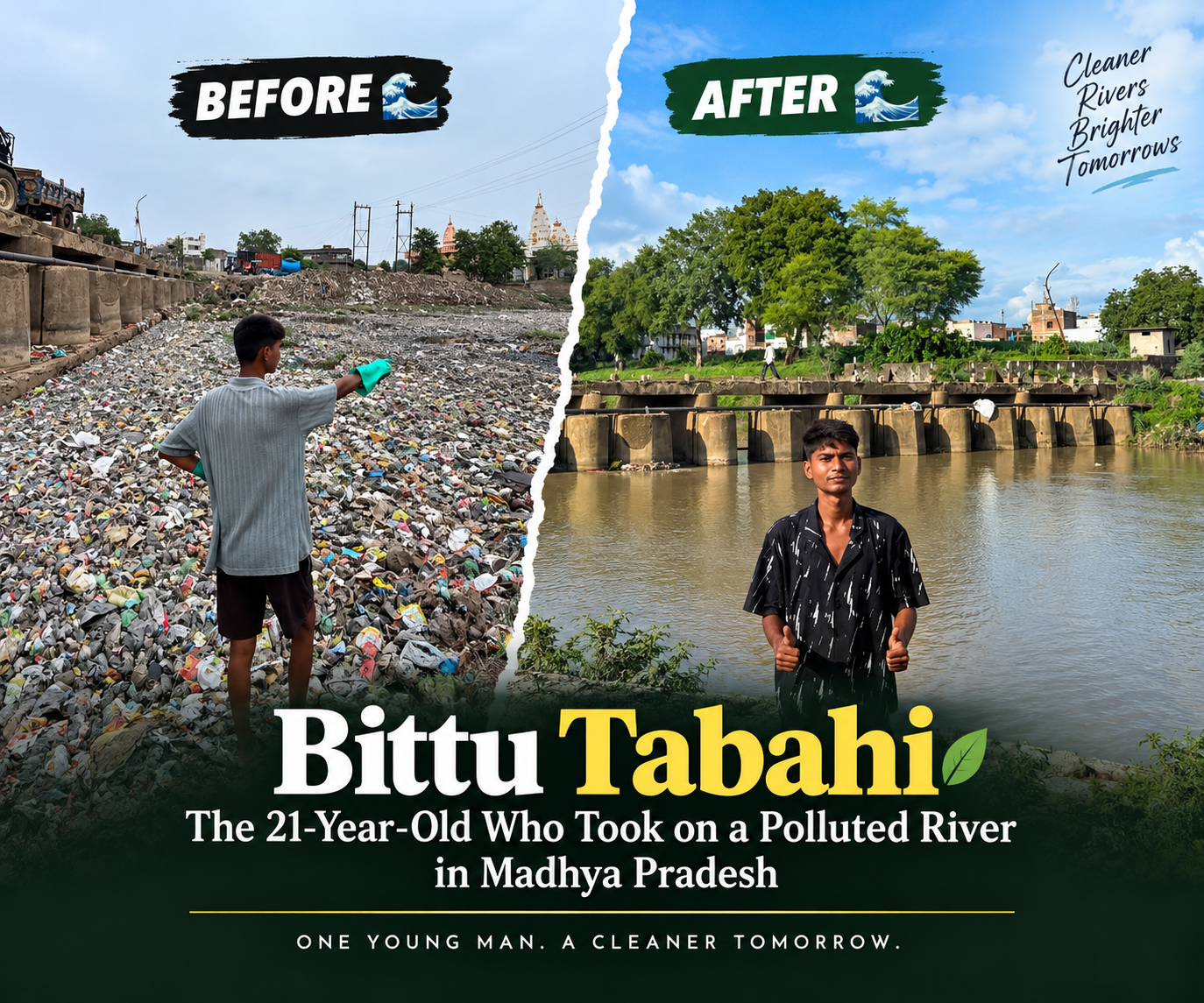
Surendra Singh Choudhary, known online as Bittu Tabahi, spent months cleaning the garbage-choked Ajnar River in Biaora with his own money, basic tools and little institutional support. What began as a personal effort has now brought him national recognition and an invitation from The Ocean Cleanup.
On a cold morning in January, a 21-year-old student from Biaora in Madhya Pradesh stepped into the polluted waters of the Ajnar River. He did not have a government order, a large volunteer group or heavy machinery waiting for him. He had basic tools, his own money and a problem that had bothered him for years.
That student was Surendra Singh Choudhary, better known online as Bittu Tabahi.
For months, Bittu kept returning to the river, removing plastic bottles, weeds, algae and other accumulated waste from its ghats. What started with a few friends gradually became an effort he largely continued on his own. His work eventually moved from the banks of a local river to national headlines, social media feeds and, eventually, the attention of one of the world’s best-known ocean-cleanup organisations.
But the story of Bittu Tabahi is not only about a young man cleaning a polluted river. It is also about what happens when an environmental problem becomes so familiar that people stop seeing it as a problem at all.
Why Bittu Tabahi Started Cleaning the Ajnar River
Bittu grew up around the Ajnar River and regularly visited the area around a temple near the waterway. Over time, the garbage accumulated around the river began to trouble him enough that he decided to act.
According to reports, he began his cleanup effort on January 26, 2026. In the beginning, he was joined by friends, but as the weeks passed, their involvement reduced. Bittu continued going back, sometimes spending several hours a day working along the river.
The work was not easy. He did not initially have proper equipment, protective clothing or machinery. Reports say he spent his own money buying supplies and eventually put around ₹30,000 into the effort. He also faced health problems while working in the polluted water and encountered snakes and other hazards along the riverbank.
There was no guarantee that anyone would notice.
He continued anyway.
From a Local Cleanup to a Viral Story
The transformation in Bittu’s story came when he began documenting his work. Before-and-after photographs and videos showed the condition of the river and the changes taking place at the stretches he worked on.
The images travelled much further than Biaora.
People began sharing his work on social media, and Bittu’s name started appearing in conversations about India’s polluted rivers and the role individuals can play in environmental conservation. His effort was eventually noticed by public figures, including former England cricketer Kevin Pietersen, while industrialist Anand Mahindra also praised the initiative.
Then came the response that took the story to another level.
Boyan Slat, the founder and CEO of Netherlands-based environmental organisation The Ocean Cleanup, invited Bittu to work with the organisation after seeing the attention around his river-cleaning effort.
Slat’s message was remarkably simple: “Come work for us.” For a young student who had begun cleaning a river in his hometown, the invitation represented an extraordinary leap from local action to an international environmental platform.
What Bittu Actually Cleaned
The viral nature of the story has sometimes made the claim sound larger than the reality on the ground, so the details matter.
Bittu’s effort has focused on stretches and ghats along the Ajnar River rather than magically solving every pollution problem affecting the entire waterway. He has reportedly worked across three major ghats, with the time required for each section varying considerably. He told Hindustan Times that the first ghat alone took roughly two to three months, while he continued working on other sections.
The local municipality has also become involved. According to NDTV, municipal authorities provided heavy machinery to assist with the removal of accumulated waste, while local citizens contributed to the broader cleanup.
That distinction does not diminish Bittu’s contribution. If anything, it makes the story more meaningful. He did not single-handedly solve a city’s river-pollution problem. He started doing the work that had become easy for everyone else to ignore, and his persistence eventually helped bring other people and institutions into the effort.
The River Still Needs More Than a Cleanup
This is where the story of Bittu Tabahi becomes bigger than Bittu himself. Removing visible garbage can change the appearance of a river, but it cannot by itself solve the systems that make a river polluted in the first place. Waste disposal, sewage, drainage, enforcement and civic behaviour all determine what eventually reaches a waterway.
In Biaora, that wider problem has not disappeared simply because one section of the Ajnar looks cleaner.
NDTV reported that the local administration has proposed a ₹14.77 crore sewage treatment plant, highlighting the fact that the river’s long-term health will depend on infrastructure as much as individual effort.
This is an important part of the story because India does not have a shortage of people willing to celebrate a clean river. The harder challenge is building systems that prevent the river from becoming polluted again.
Bittu can remove garbage. He cannot, by himself, redesign a city’s waste-management system.
Why Bittu Tabahi’s Story Has Resonated
Perhaps the reason Bittu’s story has travelled so quickly is that it is unusually uncomplicated. He saw something wrong in a place he knew and decided to do something about it. There was no large campaign when he started. There was no guarantee of recognition. In fact, reports say people initially mocked him for entering the polluted water. Yet he kept returning. That persistence is what separates a social-media gesture from sustained action.
His story also challenges a familiar assumption about environmental work: that meaningful change requires a large organisation, substantial funding or sophisticated technology. Those things are certainly necessary for solving environmental problems at scale, but Bittu’s experience shows that the first step can still begin with an individual.
And sometimes, the first step is what gets everyone else moving.
The Attention Comes With a Responsibility
Bittu’s sudden popularity has also brought scrutiny. As his story spread, questions emerged around the extent of the cleanup and the role of municipal authorities. Bittu has maintained that his motivation was not personal credit and has pushed back against suggestions that his work was primarily about publicity.
That debate is worth keeping in perspective. Environmental work should not become a contest over who gets the photograph. Whether the garbage was removed by Bittu, municipal workers, local residents or machinery is ultimately less important than whether it stays out of the river.
The real measure of success will not be the number of viral posts about Bittu Tabahi. It will be whether the Ajnar River remains cleaner months and years from now.
https://www.instagram.com/p/DdBc1ccyV_d/?hl=en
The Wise Take
Bittu Tabahi’s story is easy to turn into an inspirational headline: a young man saw a dirty river, entered the water and began cleaning it with his own hands. That part is true, and it is worth celebrating. But the more important lesson lies beyond the image of one person standing in polluted water.
A river cannot depend on a single citizen’s determination to remain clean. Individual action can draw attention to a problem, change public behaviour and force institutions to respond, but it cannot replace the systems needed to protect a waterway permanently. The Ajnar needs waste management, sewage treatment, enforcement and a community that understands that throwing something into a river does not make the problem disappear.
What makes Bittu’s effort valuable is therefore not simply the amount of waste he has removed. It is the fact that he refused to accept the condition of the river as normal. He looked at something people had grown accustomed to seeing and decided that familiarity was not a reason to tolerate it.
The wisest outcome of his story would not be for India to produce a thousand more people willing to enter polluted rivers with their bare hands. It would be for fewer young Indians to feel that they have to.
Bittu started by cleaning a river. The real success will be if the people around it decide they no longer want to dirty it.



