
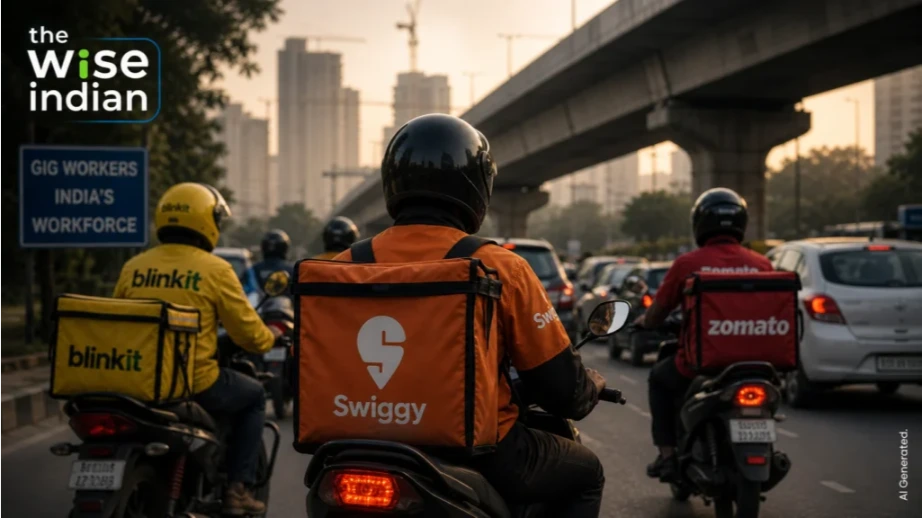
With the four labour codes now operational and central rules notified, delivery riders and cab drivers are formally recognised workers. What that recognition delivers is still being built.
For most of the last decade, India’s app-based workforce existed in a legal gap. Delivery partners, cab drivers and home-service professionals were neither employees nor quite independent contractors, which meant they were largely outside the country’s social security architecture.
That gap has been narrowing. The Code on Social Security, 2020, which came into force on 21 November 2025, defines gig workers and platform workers in Indian labour law for the first time, and the central rules under the four labour codes were notified in May 2026.
What the Code Actually Recognises
The Code defines a gig worker as someone who earns from a work arrangement outside the traditional employer and employee relationship. It provides for social security measures covering life and disability cover, accident insurance, health and maternity benefits, and old age protection.
It also provides for a Social Security Fund to finance these measures, with aggregator platforms expected to contribute a share of turnover towards it. Aggregator contributions were discussed in the rule-making process as a percentage of annual turnover, subject to a ceiling linked to total payments made to gig workers on the platform.
Registration Is the Gateway
Access to most benefits runs through registration on the e-Shram portal. Workers can register themselves or through assisted channels such as Common Service Centres, and platforms are expected to help enrol new workers.
Government figures cited in 2025 showed more than thirty crore unorganised workers registered on e-Shram, though the platform and gig worker share of that total was a much smaller number. Closing that gap is the immediate operational challenge. Registration also carries a second function beyond benefits, which is data. Without a reliable count of who is working on which platform, designing a welfare scheme that reaches them remains guesswork.
States Have Moved Ahead of the Centre
Rajasthan and Karnataka introduced their own platform worker welfare legislation before the central framework was operational, providing for registration, welfare boards and welfare funds, with Karnataka’s model also addressing grievance redressal and account deactivation.
Where a state law applies, it runs alongside the central Code. Workers in those states may therefore have recourse to both state and national mechanisms, which is a genuine advantage and also a source of confusion.
What Remains Unsettled
Several elements are still being operationalised scheme by scheme, including the extension of health coverage under Ayushman Bharat Pradhan Mantri Jan Arogya Yojana to registered gig workers, which the government has said will follow.
Draft rules also discussed a minimum engagement threshold in a financial year before a worker qualifies for benefits, a proposal worker representatives have questioned on the grounds that it could exclude irregular earners. The underlying classification debate has not been resolved.
The Wise Take
It is easy to read this as either a breakthrough or an empty gesture, and neither reading holds up well. Recognition in law is not the same as money in a worker’s hand, and a fund that exists on paper helps nobody until disbursal works. But the reverse is also true. Nothing gets built for a category of worker the law does not acknowledge exists, and that acknowledgement has now happened. The useful question for the next two years is not whether India has legislated for gig workers. It has. The question is how many riders and drivers are actually registered, and how quickly a claim gets paid.