
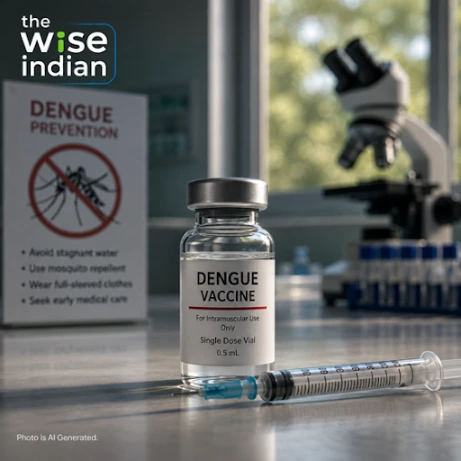
The drug regulator has authorised Takeda’s Qdenga for people aged 4 to 60, in a country where dengue has become the most common vector-borne disease.
In most Indian cities, the monsoon arrives with a familiar sequence. Water collects, mosquitoes breed, and hospitals begin counting platelets.
For the first time, India has a licensed vaccine against the disease at the centre of that sequence.
What Has Been Approved
On 21 July 2026, the Drugs Controller General of India granted marketing authorisation to Takeda’s dengue vaccine, TAK-003, sold as Qdenga.
The approval covers individuals aged 4 to 60 years and applies regardless of previous dengue exposure, without any requirement for pre-vaccination testing. The vaccine is a live attenuated tetravalent formulation covering all four dengue serotypes, given as two doses three months apart.
The Health Ministry said more than 24 million doses have been distributed worldwide, with no major safety concerns reported so far.
The Burden the Vaccine Enters
Dengue is now India’s most common vector-borne disease. Official data cited by the ministry records more than one million cases and at least 1,500 deaths since 2021.
The seasonal assumption is also weakening. Several states now report sustained year-round transmission, in both urban and rural areas, rather than a burden confined to the monsoon months.
Dengue is caused by four related virus serotypes, which is why a vaccine covering all four matters. Infection with one serotype does not protect against the others, and the mosquito that carries them breeds readily in the clean water stored in and around homes.
That is also why the vaccine does not displace the ordinary work of prevention, which remains clearing stagnant water, covering stored water and preventing bites.
What Approval Does Not Settle
A marketing authorisation establishes that a vaccine may be sold. It does not by itself determine price, distribution, or whether the vaccine will be included in any public immunisation programme.
An Indian candidate is also in development. Panacea Biotec’s DengiAll has entered the final stage of clinical trials and, if approved, would be among the world’s first single-dose dengue vaccines. Individual decisions about vaccination are best taken with a doctor who knows the person’s medical history.
The Wise Take
Dengue has resisted the tools that worked against other epidemics in India, because it is not spread by contaminated water or crowding alone but by a mosquito that breeds in the clean water people store at home. Fogging campaigns and awareness drives have never fully closed that gap. A vaccine changes the arithmetic without replacing the basics, since four serotypes and an urban mosquito remain difficult opponents. What matters over the next two years is less the approval itself than the questions that follow it: who can afford it, who is prioritised, and whether an indigenous single-dose option arrives to widen the answer