
App-based transport in the state now requires a licence, with surge pricing capped and every aggregator told to register by 1 September.
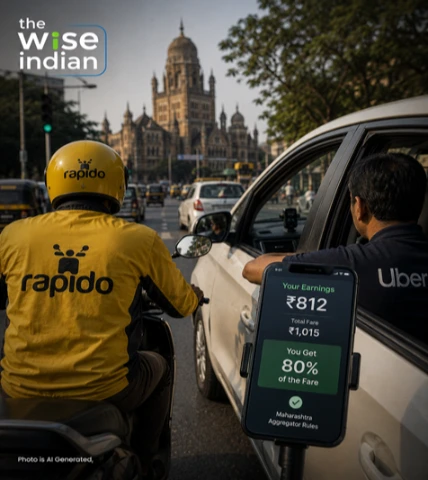
For most drivers on ride-hailing apps, the number that matters is not the fare shown to the passenger. It is what remains after the platform takes its share.
Maharashtra has now put a floor under that number.
App-based transport has become part of daily commuting in the state’s cities, but it has operated without a uniform rulebook, and complaints over fares, cancellations and driver verification have accumulated alongside the growth.
What the Policy Requires
The state government notified a new Aggregator Policy on 16 July 2026, bringing app-based taxi, auto-rickshaw and bike taxi operators under a single regulatory framework.
Every aggregator must obtain a licence from the State Transport Authority. Drivers are guaranteed at least 80 percent of the total fare, surge pricing is capped, and carpooling has been given legal recognition.
Transport Minister Pratap Sarnaik said the policy is intended to balance passenger safety, driver welfare and employment opportunities for local youth.
Safety Provisions and Local Hiring Conditions
Aggregators are required to run round-the-clock call centres and appoint dedicated grievance officers. The policy includes safety measures directed at women passengers, among them ride-pooling options restricted to female riders.
Driver registration carries conditions tied to the state, including Marathi language proficiency and proof of residence. The policy also encourages a gradual shift towards electric and alternative-fuel vehicles.
A Deadline Now Attached to It
On 30 July, Sarnaik said every ride-hailing aggregator operating in Maharashtra must complete mandatory registration with the Transport Department by 1 September 2026.
Companies that miss the deadline face legal consequences, which the minister indicated could include restrictions on their operations in the state.
Uber, Ola and Rapido are among the platforms covered by the framework.
The state government said the absence of uniform regulation had previously led to concerns about passenger safety, arbitrary surge pricing, delayed grievance redressal and lost state revenue, and that the policy is meant to provide a legal and accountable framework in their place.
The Wise Take
India has spent close to a decade arguing about whether app-based drivers are partners or workers, and the argument has rarely produced anything a driver could bank. A guaranteed 80 percent share is a different kind of intervention, because it is measurable. Either the deposit reflects it or it does not. The harder questions arrive next. Enforcement will depend on whether the state can audit what platforms actually pay, and a fare floor set in one state does little for drivers elsewhere. Maharashtra has also linked registration to local language and residence requirements, which will shape who gets to drive as much as what they earn. The value here is that a number now exists to be held to.